A Blurry Microscope Image Rewrote How Frost Spreads
A Blurry Microscope Image Rewrote How Frost Spreads
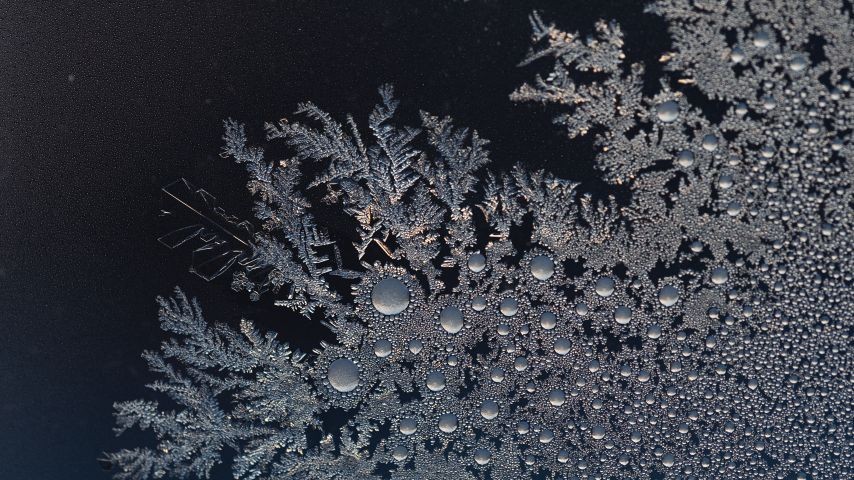
A microscopy discovery shows superhydrophobic surfaces suspend ice bridges, slowing frost spread and improving heat exchanger performance.
On a cold surface, frost spreads from droplet to droplet in a chain reaction. When one supercooled droplet freezes, it grows a microscopic “ice bridge” that reaches across the gap to its neighbor. The moment the bridge makes contact, that droplet freezes too, and the cascade continues. For decades, researchers assumed these bridges grew along the cold surface itself; a reasonable assumption, since nearly every study observed them from directly above.
That assumption told only half the story. In a paper published in Nature Physics, researchers at the University of Illinois Urbana-Champaign (UIUC) showed that on extremely water-repellent, superhydrophobic surfaces, ice bridges didn’t crawl along the surface at all. They formed suspended in mid-air, never touching the surface, and grew far more slowly.
As a result, frost spread up to 85 percent slower on superhydrophobic surfaces than on water-loving, hydrophilic ones, and superhydrophobic coatings that promoted the suspended ice-bridging mode roughly doubled the time frost took to overwhelm commercial heat exchangers. Behind the numbers sits a simple design target: make droplets round enough, past a threshold near 105 degrees, and frost must take the slow road.
Droplet shape
The mechanism traces back to simple geometry. Water molecules attract each other, and that attraction, called surface tension, tries to pull droplets into a sphere, the shape with the least surface area. The surface underneath pulls back. A hydrophilic surface attracts water strongly and drags the droplet down into a flattened cap; a superhydrophobic surface barely attracts water, so surface tension wins and the droplet forms a sphere perched on a tiny contact patch.
.jpg?width=400&height=346&ext=.jpg) A diagram of ice bridging under different contact angles. Image: Nature Physics
A diagram of ice bridging under different contact angles. Image: Nature Physics
Researchers quantify droplet shape by contact angle, the angle between the surface and the droplet’ edge, measured on the water side. At 90 degrees, the droplet forms a half-sphere with its widest point at the surface. Above 90 degrees, it bulges past vertical, lifting its widest point, and the shortest path to its neighbor, off the surface.
Additionally, the ice bridge itself measures roughly three microns thick, so full suspension requires droplets somewhat rounder than a half-sphere. Through experiments and simulations, the team pinned the transition at approximately 105 degrees. Below roughly 100 degrees, bridges hugged the surface; above 110 degrees, more than 90 percent formed in mid-air.
Slower bridges, slower frost
The suspended mode matters because mid-air makes a hostile place for ice to grow. A surface bridge hugs the cold surface along its entire length, which keeps it cold and feeds its growth. A suspended bridge sits surrounded by warmer air, and the longer it stretches, the warmer its tip gets and the weaker its growth becomes. With droplet spacing held constant, surface bridges grew two to three times faster than suspended ones. That microscale difference compounded across every material tested: frost spread up to 85 percent slower on superhydrophobic silicon, copper, aluminum, glass, and titanium.
The team then coated commercial finned-tube heat exchangers and tested them in a wind tunnel, flowing humid air across coils chilled to −10 degrees celsius. The uncoated unit began frosting within about 10 minutes, and its thermal output fell sharply within an hour. The coated unit delayed visible frost until about 70 minutes and sustained higher heat transfer for up to 90 minutes.
“On real heat exchangers, the superhydrophobic coating delayed the frost onset and mitigated the frost spread compared to hydrophilic and other coatings,” Yang said. “But it cannot fully prevent frosting.”
Singular focus
The discovery began with a focusing problem. An ice bridge measures only a few microns thick. Capturing one from the side demands high magnification, which comes with a razor-thin depth of field. Because droplets condense and freeze randomly both spatially and temporally, a bridging event rarely lands inside that narrow focal window. Thus, researchers defaulted to top-down imaging, which flattened the bridge into a two-dimensional profile and hid its elevation entirely.
You May Also Enjoy: Advancing Neuroscience with a Mini Microscope
You May Also Enjoy: Advancing Neuroscience with a Mini Microscope
That elevation revealed itself by accident. While studying frosting, Yang used focal plane shift imaging (FPSI), a technique that pairs a high-resolution optical microscope with a precisely calibrated focus knob. Though it images from above, FPSI can pinpoint the height of anything that comes into focus.
“When I focused on the superhydrophobic surface, the ice bridge became blurry, and when I focused on the ice bridge, the surface became blurry,” Yang said. “They could not come into focus at the same time, which meant they sat at different heights. That was when I realized it might be a suspended mode.&rdquo
Three lines of defense
If suspension kicks in at 105 degrees, ordinary hydrophobic coatings might seem sufficient. They typically reach 110 degrees to 125 degrees and survive real-world abuse better than delicate superhydrophobic textures. However, suspended bridging marks only one of three ways a superhydrophobic surface fights frost. Before any bridging can start, superhydrophobic surfaces suppress ice nucleation itself, delaying the onset of frost rather than just slowing its spread. Then, as droplets grow and merge, the low liquid-solid adhesion on superhydrophobic surfaces enables coalescence-induced jumping: the energy released when two droplets combine launches the merged droplet off the surface. Fewer droplets, spaced farther apart, give frost fewer and longer gaps to bridge. On a merely hydrophobic surface, merged droplets stay put, crowding together into short gaps that bridges cross quickly.
For engineers who battle frost on coils, cores, and airframes, the takeaway lands simply: fighting frost starts with surface wettability, how strongly a surface grips water. A surface that barely grips, lets droplets bead past 105 degrees and lift their ice bridges into mid-air, and lets merged droplets launch off entirely. Rather than a new coating, the work delivers something arguably more useful: a physical design target, grounded in geometry, for every anti-frosting surface that follows.
Nicole Imeson is an engineer and writer in Calgary, Alberta.
A microscopy discovery shows superhydrophobic surfaces suspend ice bridges, slowing frost spread and improving heat exchanger performance.

Principal at Vertica Engineering and freelance writer
Related Content


Sep 24, 2026
ASME Foundation and Westinghouse Join Forces to Build Local Engineering and Manufacturing Talent Pipeline in Shoreview, Minnesota
Sep 23, 2026
Computer Model Could Improve Sustainability for Construction Industry


MIT researchers developed an accessible computer model that helps engineers design practical truss structures with less material, reducing carbon emissions.
Sep 23, 2026
From Student Section Builder to Aerospace Engineer


Rebuilding a ASME student section and mentoring student leaders, Kenny Madden gained the technical, professional, and leadership skills needed to pursue an aerospace career.
Sep 23, 2026
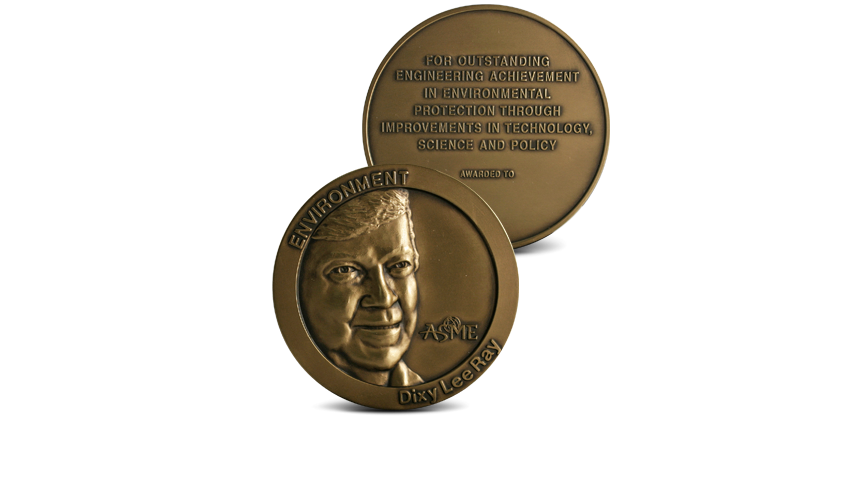
H. Christopher Frey Receives 2026 Dixy Lee Ray Award