A Cooler Data Center
A Cooler Data Center
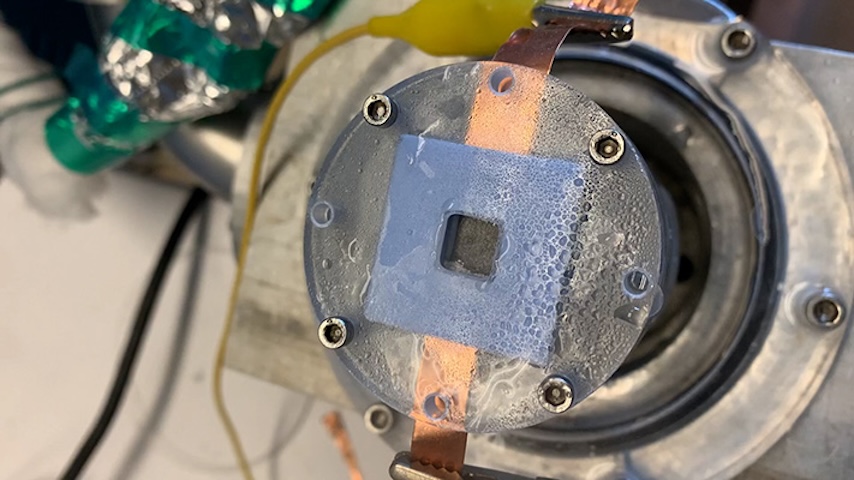
Engineered fiber membranes may hold key to effective evaporative cooling in data centers.
As the impacts of AI and the overall increase in global data usage continue to play out in the energy infrastructure landscape, the need for data processing and the home that allows it to happen is creating a “surge” in data center construction. That data processing generates tremendous amounts of heat, requiring cooling to prevent failure, and that cooling need accounts for up to 40 to 50 percent of a data center’s overall energy use. This growth is expected increase the total energy consumption used for data center cooling by 160 percent by 2030, surpassing 1,000 terawatt-h (TWh), according to a research team from the University of California, San Diego.
“It is happening very fast, and there are a lot of data centers being deployed as we speak, and they are trying to use a large amount of power and water,” said Renkun Chen, a professor in the Department of Mechanical and Aerospace Engineering at the UC San Diego Jacobs School of Engineering and lead author of recently published research that says engineered fiber membranes could be part of the solution.
Chen said the team’s research project is the latest step in nearly a decade spent by engineers aiming to improve evaporative cooling techniques.
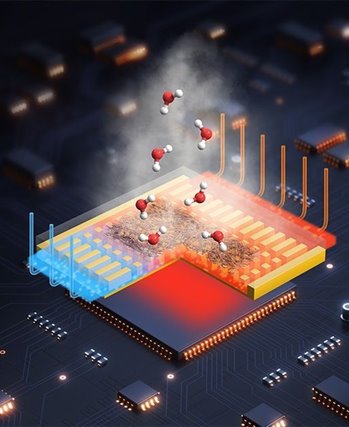 An illustration of a fiber membrane removing heat from an electronic chip through evaporation. Photo: Tianshi Feng
“We are trying to remove a very, very, large amount of heat from way small areas,” Chen explained.
An illustration of a fiber membrane removing heat from an electronic chip through evaporation. Photo: Tianshi Feng
“We are trying to remove a very, very, large amount of heat from way small areas,” Chen explained.
The UCSD research team also includes Chen’s fellow department professors Shengqiang Cai and Abhishek Sahaand, as well as mechanical and aerospace engineering doctoral student Tianshi Feng and postdoctoral researcher Yu Pei, both members of Chen’s research group, who are co-first authors on the study.
Among the challenges in the approach was finding a membrane with a relaxed surface area that can sustain high heat flux and vibration, he said. The solution came from the filtration community, where the use of these kinds of membranes for separation and filtration have become commonplace.
“These membranes, because of the fiber, provide very large surface areas, but also they are mechanically more robust compared to other type of membranes,” Chen said.
The high-performing three-dimensional engineered fiber membrane design includes open pores that rapidly and uniformly help draw cooling liquid across its surface using capillary action. The network of fibers and pores had to be built with openings at just the right size to avoid clogging from pores that were too small or the “chaotic boiling” that could erupt in pores too large. Heat is passively removed as the liquid evaporates.
The research is also the fundamental basis of a prototype product the team is continuing to develop called “cold plate” technology.
Discover the Benefits of ASME Membership
This cold plate, which includes the engineered fiber membrane, would be attached to, or cover, a CPU or GPU chip, sitting directly on top of processors to help dissipate heat via evaporative cooling.
The team’s research showed the engineered fiber membrane achieved a critical heat flux that exceeds 800 W cm² across a 0.5 cm² heating area, a record setting performance among capillary-driven evaporators of similar size. This proccess proved the performance levels could be sustained for several hours.
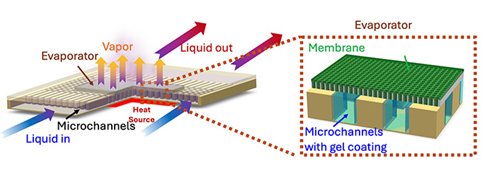 An illustration of the fiber membrane pulling liquid from microchannels into its pores through capillary action and cooling a heat source as the liquid evaporates. Photo: Tianshi Feng
After seeing the results on evaporative cooling, the team realized, “we need to integrate this membrane into this cold plate type of device,” Chen continued. The idea is to apply the cold plate technology to any given chip, regardless of the manufacturer.
An illustration of the fiber membrane pulling liquid from microchannels into its pores through capillary action and cooling a heat source as the liquid evaporates. Photo: Tianshi Feng
After seeing the results on evaporative cooling, the team realized, “we need to integrate this membrane into this cold plate type of device,” Chen continued. The idea is to apply the cold plate technology to any given chip, regardless of the manufacturer.
The chip manufacturer specifies the cooling requirement for its respective chip, working with the data center engineering team to integrate the cold plate technology into the data center’s overall HVAC systems design, he explained.
Although Chen didn’t have an exact estimate of how much this technology will reduce overall power demand within a data center yet, “what I can say is the energy consumption for cooling in data center using this type of technology will be substantially reduced,” he said.
Take This Quiz: Reusing Data Center Waste Heat
The team is looking for opportunities to test the cold plate technology in an actual device as part of a real-life scenario. It’s part of an overall effort to develop partners to help bring the technology to market. And development of a commercial product requires more than research performance.
“Other aspects, like reliability, durability, and such,” come into play because, “when you actually implement it into a server, you want it to work for like five to 10 years, without any incident,” Chen said. “These chips are really expensive, so reliability is the word.”
He’s excited not only about the potential impact of the technology on data center energy demand, but also its use in other high power electronic device applications.
“This is a very exciting time for mechanical engineers,” when it comes to data center design, energy, and environmental sensibility, Chen added. “It’s a very big issue, and it’s actually very pressing,” and “engineers can really make an impact in this area.”
Nancy Kristof is a technology writer in Denver.
“It is happening very fast, and there are a lot of data centers being deployed as we speak, and they are trying to use a large amount of power and water,” said Renkun Chen, a professor in the Department of Mechanical and Aerospace Engineering at the UC San Diego Jacobs School of Engineering and lead author of recently published research that says engineered fiber membranes could be part of the solution.
Chen said the team’s research project is the latest step in nearly a decade spent by engineers aiming to improve evaporative cooling techniques.
An illustration of a fiber membrane removing heat from an electronic chip through evaporation. Photo: Tianshi Feng
The UCSD research team also includes Chen’s fellow department professors Shengqiang Cai and Abhishek Sahaand, as well as mechanical and aerospace engineering doctoral student Tianshi Feng and postdoctoral researcher Yu Pei, both members of Chen’s research group, who are co-first authors on the study.
Among the challenges in the approach was finding a membrane with a relaxed surface area that can sustain high heat flux and vibration, he said. The solution came from the filtration community, where the use of these kinds of membranes for separation and filtration have become commonplace.
“These membranes, because of the fiber, provide very large surface areas, but also they are mechanically more robust compared to other type of membranes,” Chen said.
The high-performing three-dimensional engineered fiber membrane design includes open pores that rapidly and uniformly help draw cooling liquid across its surface using capillary action. The network of fibers and pores had to be built with openings at just the right size to avoid clogging from pores that were too small or the “chaotic boiling” that could erupt in pores too large. Heat is passively removed as the liquid evaporates.
The research is also the fundamental basis of a prototype product the team is continuing to develop called “cold plate” technology.
Discover the Benefits of ASME Membership
This cold plate, which includes the engineered fiber membrane, would be attached to, or cover, a CPU or GPU chip, sitting directly on top of processors to help dissipate heat via evaporative cooling.
The team’s research showed the engineered fiber membrane achieved a critical heat flux that exceeds 800 W cm² across a 0.5 cm² heating area, a record setting performance among capillary-driven evaporators of similar size. This proccess proved the performance levels could be sustained for several hours.
An illustration of the fiber membrane pulling liquid from microchannels into its pores through capillary action and cooling a heat source as the liquid evaporates. Photo: Tianshi Feng
The chip manufacturer specifies the cooling requirement for its respective chip, working with the data center engineering team to integrate the cold plate technology into the data center’s overall HVAC systems design, he explained.
Although Chen didn’t have an exact estimate of how much this technology will reduce overall power demand within a data center yet, “what I can say is the energy consumption for cooling in data center using this type of technology will be substantially reduced,” he said.
Take This Quiz: Reusing Data Center Waste Heat
The team is looking for opportunities to test the cold plate technology in an actual device as part of a real-life scenario. It’s part of an overall effort to develop partners to help bring the technology to market. And development of a commercial product requires more than research performance.
“Other aspects, like reliability, durability, and such,” come into play because, “when you actually implement it into a server, you want it to work for like five to 10 years, without any incident,” Chen said. “These chips are really expensive, so reliability is the word.”
He’s excited not only about the potential impact of the technology on data center energy demand, but also its use in other high power electronic device applications.
“This is a very exciting time for mechanical engineers,” when it comes to data center design, energy, and environmental sensibility, Chen added. “It’s a very big issue, and it’s actually very pressing,” and “engineers can really make an impact in this area.”
Nancy Kristof is a technology writer in Denver.
Engineered fiber membranes may hold key to effective evaporative cooling in data centers.

Freelance writer and editor
Related Content


Apr 2, 2026
On The Move: Driving The Future of Transportation


Apr 2, 2026
Ultra-Fine 3D Printing with a Mosquito’s Mouth


A nature-inspired solution merges the feeding tube of a mosquito with a 3D printer that can achieve a surprising resolution.
Apr 1, 2026
Workforce Blog: Strategic Philanthropy Closes the Talent Gap
Corporate partners invest in workforce development and the greater good.
Apr 1, 2026
Additive Screen Printing: Technology and Scalability for Micro-Structured Components

A screen-based additive process enables the mass production of high-resolution metal and ceramic components at industrial scale.