Advancing Neuroscience with a Mini Microscope
Advancing Neuroscience with a Mini Microscope
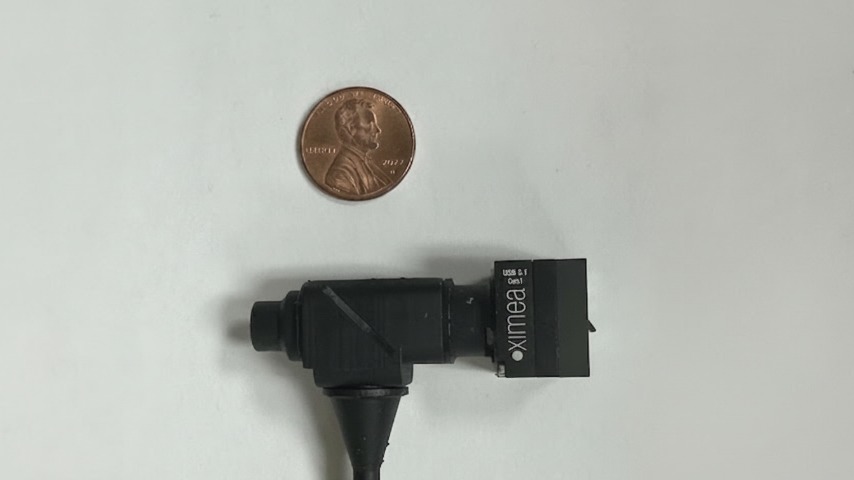
Researchers have built a miniature lightweight microscope that captures neuron activity in moving animals.
Alzheimer’s disease and other neurological disorders have medical researchers working day and night for a cure. It’s challenging because the brain is still a very mysterious organ, but a newly developed miniature microscope could help shed new light on how the brain works.
This miniature lightweight microscope, called the MiniVolt, captures neuron activity with unprecedented speed and can be used in freely moving animals. The new tool, which was developed with funding from the National Institutes of Health’s BRAIN Initiative, could give scientists a more complete view of how brain cells process information during natural behavior.
Although miniature microscopes are already in use, they cannot measure images quickly enough to capture membrane voltage, explained Emily Gibson, associate professor of bioengineering at the University of Colorado Anschutz School of Medicine and one of several researchers on this project. That’s what makes the MiniVolt special.
“Unlike most miniature microscopes that track slower calcium signals, ours captures electrical spikes at hundreds of frames per second,” Gibson said. “This makes it possible to capture the moment a neuron fires as well as the quieter signals that build up inside neurons before firing.”
More for You: A Mechanical Biomarker for Brain Health?
Researchers inject fluorescent proteins into the neuron’s membrane, and the fluorescence changes when there’s a change in the membrane voltage across the cell. Voltage changes in the brain are driven by ion flow across neuron membranes, creating rapid electrical signals called action potentials.
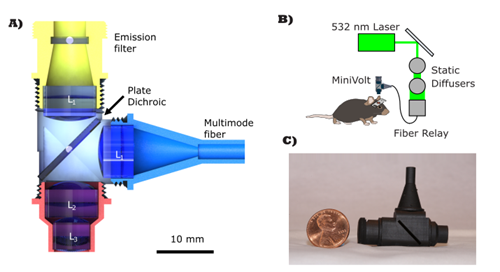 (a) CAD schematic showing a cross-sectional view of MiniVolt. (b) Zemax optical design for the emission path of MiniVolt. (c) Image of a 50 micron fluorescent grid target taken with MiniVolt. (d) Photo of MiniVolt next to a penny for size reference. Image: Saladrigas, et al.
The process starts with small voltage changes that eventually reach a threshold, triggering a chain reaction that causes sodium ions to rush in and then potassium ions to rush out. This creates the spike of action potential. Observing these voltage changes can give researchers more insight into the brain, including how it learns and remembers things.
(a) CAD schematic showing a cross-sectional view of MiniVolt. (b) Zemax optical design for the emission path of MiniVolt. (c) Image of a 50 micron fluorescent grid target taken with MiniVolt. (d) Photo of MiniVolt next to a penny for size reference. Image: Saladrigas, et al.
The process starts with small voltage changes that eventually reach a threshold, triggering a chain reaction that causes sodium ions to rush in and then potassium ions to rush out. This creates the spike of action potential. Observing these voltage changes can give researchers more insight into the brain, including how it learns and remembers things.
“As a neuron fires, you see this very fast fluctuation in membrane voltage; it happens in hundreds of microseconds,” Gibson said. The MiniVolt can capture that activity because it records 500 frames per second, compared to the 20 frames per second of current miniature microscopes. The new microscope also has a higher numerical aperture of 0.6, allowing researchers to collect more of the fluorescent signal. The tool was described in a recent article published in Biomedical Optics Express.
The other important feature of the MiniVolt is its weight. It has to be light enough for a mouse to hold on its head while it’s freely moving. Researchers want to use the microscope to study the brains of active mice because there are many human disease models in mice.
“We came close, but we’re still working on it,” Gibson said. “Mice can only support about 5 grams or less, but our device is about 16 grams. We have some ideas for how to reduce the weight. That’s our next step.”
Discover the Benefits of ASME Membership
At its current weight, researchers have been able to test the MiniVolt in head-fixed mice that are awake, but to understand the brain’s spatial navigation and visual system, it’s critical to observe neuron activity in a freely moving animal. “You really need to study the whole circuit in a dynamic manner,” Gibson said.
For experiments with a freely moving mouse, researchers will insert the microscope into a small, 3D printed base plate and then glue it onto the animal’s head. “It’s like a little hat,” Gibson said. “The animal will then go into an arena and do a behavior. Then, when you’re done doing those measurements, you can detach the hat.”
This type of research will lead to a greater understanding of the brain and how the brain’s memory is diminished with conditions like Alzheimer’s disease, among other insights.
“It will allow new studies of neurocircuits, especially using voltage. We’ll be able to measure the rates at which the cells fire, timing between cells, and do all of this in real behavior studies,” Gibson said. “Also, you can use it to measure what’s called subthreshold voltage oscillations in the brain. These are important for understanding how different brain areas communicate across the network.”
You Might Also Enjoy: A Large-Format Solution for 3D Microscopes
The MiniVolt could also eventually be used in other studies neuroscientists are doing to understand the connection between the brain and other parts of the body. “I think that using these optical techniques to study this in living systems would lead to a lot of new understanding of all these pathways—what’s going on in the brain and how the brain communicates with other organs,” Gibson said.
Developments like the MiniVolt are a first step toward understanding and finding cures to vexing neurological diseases and disorders. “We’re just a small cog,” Gibson said humbly.
“But I get excited thinking about how we can take the tools developed in my lab and disseminate them to the neuroscientists, so they can do some really cool work,” she said. “That’s what we want to do in the future is really further engineer the tool and get it to the point where it could be widely available for the really exciting science that’s going on.”
Claudia Hoffacker is an independent writer in Minneapolis.
This miniature lightweight microscope, called the MiniVolt, captures neuron activity with unprecedented speed and can be used in freely moving animals. The new tool, which was developed with funding from the National Institutes of Health’s BRAIN Initiative, could give scientists a more complete view of how brain cells process information during natural behavior.
Although miniature microscopes are already in use, they cannot measure images quickly enough to capture membrane voltage, explained Emily Gibson, associate professor of bioengineering at the University of Colorado Anschutz School of Medicine and one of several researchers on this project. That’s what makes the MiniVolt special.
“Unlike most miniature microscopes that track slower calcium signals, ours captures electrical spikes at hundreds of frames per second,” Gibson said. “This makes it possible to capture the moment a neuron fires as well as the quieter signals that build up inside neurons before firing.”
More for You: A Mechanical Biomarker for Brain Health?
Researchers inject fluorescent proteins into the neuron’s membrane, and the fluorescence changes when there’s a change in the membrane voltage across the cell. Voltage changes in the brain are driven by ion flow across neuron membranes, creating rapid electrical signals called action potentials.
(a) CAD schematic showing a cross-sectional view of MiniVolt. (b) Zemax optical design for the emission path of MiniVolt. (c) Image of a 50 micron fluorescent grid target taken with MiniVolt. (d) Photo of MiniVolt next to a penny for size reference. Image: Saladrigas, et al.
“As a neuron fires, you see this very fast fluctuation in membrane voltage; it happens in hundreds of microseconds,” Gibson said. The MiniVolt can capture that activity because it records 500 frames per second, compared to the 20 frames per second of current miniature microscopes. The new microscope also has a higher numerical aperture of 0.6, allowing researchers to collect more of the fluorescent signal. The tool was described in a recent article published in Biomedical Optics Express.
The other important feature of the MiniVolt is its weight. It has to be light enough for a mouse to hold on its head while it’s freely moving. Researchers want to use the microscope to study the brains of active mice because there are many human disease models in mice.
“We came close, but we’re still working on it,” Gibson said. “Mice can only support about 5 grams or less, but our device is about 16 grams. We have some ideas for how to reduce the weight. That’s our next step.”
Discover the Benefits of ASME Membership
At its current weight, researchers have been able to test the MiniVolt in head-fixed mice that are awake, but to understand the brain’s spatial navigation and visual system, it’s critical to observe neuron activity in a freely moving animal. “You really need to study the whole circuit in a dynamic manner,” Gibson said.
For experiments with a freely moving mouse, researchers will insert the microscope into a small, 3D printed base plate and then glue it onto the animal’s head. “It’s like a little hat,” Gibson said. “The animal will then go into an arena and do a behavior. Then, when you’re done doing those measurements, you can detach the hat.”
This type of research will lead to a greater understanding of the brain and how the brain’s memory is diminished with conditions like Alzheimer’s disease, among other insights.
“It will allow new studies of neurocircuits, especially using voltage. We’ll be able to measure the rates at which the cells fire, timing between cells, and do all of this in real behavior studies,” Gibson said. “Also, you can use it to measure what’s called subthreshold voltage oscillations in the brain. These are important for understanding how different brain areas communicate across the network.”
You Might Also Enjoy: A Large-Format Solution for 3D Microscopes
The MiniVolt could also eventually be used in other studies neuroscientists are doing to understand the connection between the brain and other parts of the body. “I think that using these optical techniques to study this in living systems would lead to a lot of new understanding of all these pathways—what’s going on in the brain and how the brain communicates with other organs,” Gibson said.
Developments like the MiniVolt are a first step toward understanding and finding cures to vexing neurological diseases and disorders. “We’re just a small cog,” Gibson said humbly.
“But I get excited thinking about how we can take the tools developed in my lab and disseminate them to the neuroscientists, so they can do some really cool work,” she said. “That’s what we want to do in the future is really further engineer the tool and get it to the point where it could be widely available for the really exciting science that’s going on.”
Claudia Hoffacker is an independent writer in Minneapolis.
Researchers have built a miniature lightweight microscope that captures neuron activity in moving animals.

Independent writer and editor
Related Content

Apr 30, 2026
Engineers Scale Up Smart Ceramic Composites


Researchers scaled smart ceramics by embedding shape memory particles in ductile metal, creating a tough composite that keeps the transformation effect.

Apr 30, 2026
ASME Explores Workforce Preparedness Gaps, Honors Leaders in Mechanical Engineering Education at Annual Conference

Apr 29, 2026
Column: Making AI Work in Engineering Research

The strengths, weaknesses, and strategies necessary to soundly integrate AI into research workflows.


Apr 27, 2026
Podcast: The Enduring Legacy of Class J No. 611