Driven Engineering Advances GT Motorsports
Driven Engineering Advances GT Motorsports
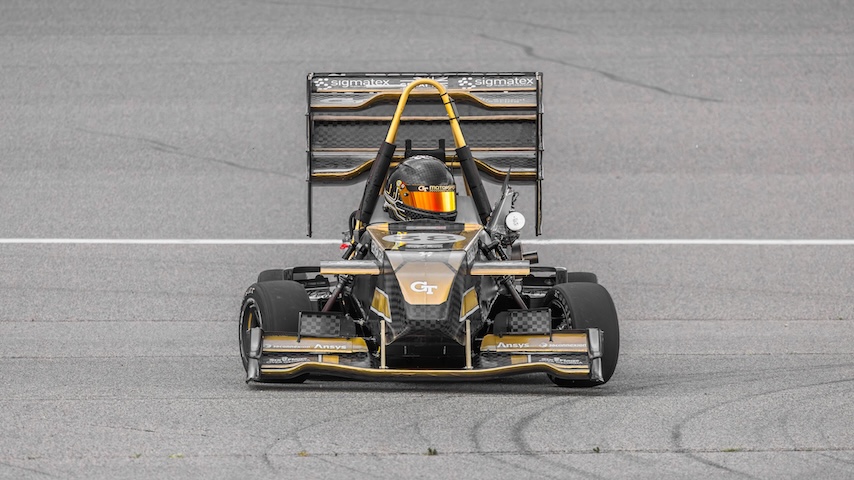
An intentional shift toward documentation, simulation, and smarter teamwork transformed a student-built race car into a podium contender, proving how engineering discipline pays off under pressure.
When the results finally rolled across the loudspeakers at Michigan International Speedway, the garage for Georgia Tech’s team GT Motorsports erupted.
“It was a very, very happy moment when we heard it was third overall,” said team lead Alexander Merryman. “We had first in endurance, which I think is the first time the team ever completed first in that event, and we got second in autocross. We did pretty well in the static events too.”
For a student team that has been designing and building race cars since 1987, the third-place overall finish at the 2025 Formula SAE (FSAE) Michigan competition—against roughly 120 international teams—was a milestone built on a year of intentional engineering, disciplined execution, and a culture shift that prioritized documentation and collaboration.
FSAE challenges collegiate teams to function like an integrated engineering organization to conceive, design, build, validate, and race a Formula-style racecar, followed by defending every decision before industry judges. Merryman, who is completing a dual degree in neuroscience and business administration, explained that they are tested as more than just students, but as full-fledged engineers.
“You actually sit down with industry experts and walk them through your design process,” he shared.
On the dynamic side, the car must tackle acceleration, skid pad, autocross, and the grueling endurance event (with an embedded efficiency score). On the static side, teams are pressed on design choices, manufacturing cost, and the viability of a business plan to produce 1,000 units.
The 2025 campaign hinged on a mindset change.
“Every decision we make has to have a reason,” Merryman said. “It’s not just, ‘it makes it better,’ but how does it make it better? What are the quantifiable metrics we’re using?”
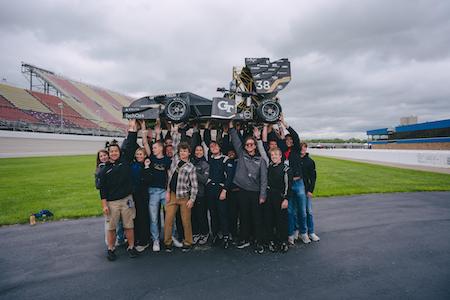 From frozen engines to blown drivetrains, a student racing team turned setbacks into momentum through smart engineering, tighter collaboration, and a renewed focus on building fast. Image: Georgia Tech
GT Motorsports turned that principle into process, with weekly “static event reps,” cost reports, design brief tune-ups, and pre-competition checklists. They credit their success to this insistence on documentation and mentorship that led to a pit crew of specialists who could swarm problems in Michigan.
From frozen engines to blown drivetrains, a student racing team turned setbacks into momentum through smart engineering, tighter collaboration, and a renewed focus on building fast. Image: Georgia Tech
GT Motorsports turned that principle into process, with weekly “static event reps,” cost reports, design brief tune-ups, and pre-competition checklists. They credit their success to this insistence on documentation and mentorship that led to a pit crew of specialists who could swarm problems in Michigan.
“We just had such a good team equipped to fix it and work together and think of solutions on the spot,” shared Emily Winters, a graduate student in mechanical engineering and the team’s driver controls lead.
Now in her fifth year with the team, Winters explains that their culture has transformed since the pandemic years.
“It’s a totally different team from when I joined,” she said. “People are less afraid to ask questions, less afraid to share ideas and we collaborate between subsystems so much better.”
Sabrina Smith, a third-year aerospace engineering student and one of the team’s composites leads, saw that cohesion firsthand at her first competition.
“Everyone slots in seamlessly,” she said. “There’s good conversation between subsystems and effective decision-making.”
Relevant Reads: 3D Printing Meets High Performance in Czinger Hypercars
The competition is the culmination of countless hours of teamwork and gives each student real-world experience that propels them toward their professional goals.
“It is incredible how much the classwork becomes real,” Winters said. “I’d go to class and learn to design a brake rotor, and then it actually worked and stopped the car.”
Driver controls members learn waterjet cutting, lathes, manual mills, CNC machines, and welding; they own tolerancing and drawings, then machine the parts they designed. One of Winters’ technical pushes was quantifying self-centering steering and integrating it with suspension kinematics.
“We’ve developed some models this year to correlate suspension data along with all of our kinematics,” she said, noting that the team builds custom steering racks and tunes across steering sweeps.
The team also widened its aperture from subsystem silos to full-vehicle behavior.
“If you operate in this bubble of just looking at brake performance, you’re missing out on all the effects of the aerodynamics on the car and how the amount of downforce on each tire is changing,” Winters noted.
With the team’s chief engineer, James Millington, they worked toward one solid vehicle simulator, then coordinated with electrical to budget for a secondary harness and added more sensors that measure forces, accelerations, tire angles, brake-line pressure, and wind-tunnel pressure taps for aero validation.
“We’ve become really good at the simulation side,” Winters said. “As we start to build the car and test in the spring, we can see how good we did.”
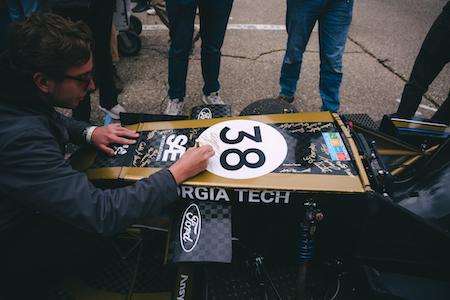 Decades of hands-on engineering paid off with a third-place overall finish, a commanding endurance win, and a strong autocross performance. Image: Georgia Tech
But even with incredible simulations, the team recognized that a vehicle this powerful also needs a capable pilot, so they added a performance director role to drive vehicle development and student driver training.
Decades of hands-on engineering paid off with a third-place overall finish, a commanding endurance win, and a strong autocross performance. Image: Georgia Tech
But even with incredible simulations, the team recognized that a vehicle this powerful also needs a capable pilot, so they added a performance director role to drive vehicle development and student driver training.
As Merryman put it, “You can have a very quick vehicle on a spec sheet but having the driver in place to actually utilize that vehicle is very important.”
As the team confidently approached race day, they thought they had everything lined up for success. But a rare winter snap in Georgia revealed a painful vulnerability: Because FSAE rules prohibit antifreeze, teams must use distilled water as coolant. Not anticipating the rare freeze, the GTMS car had been left overnight in a trailer at the dynamometer. When the team arrived the next morning, they discovered the engine block had cracked and needed full replacement.
“The night before testing was actually going awesome,” Winters said. “It was all packaged up to do powertrain tuning in the morning. But then it just didn’t crank.”
Luckily, the team was able to replace the necessary parts and compete. But that wasn’t the end of their problems. At competition, Winters recalled seeing a big cloud of smoke billow up over the car.
“One of our pistons shot through the drivetrain then through the oil pan and out onto the asphalt,” Winters said. A post-mortem analysis pointed to a fastener issue. “It wasn’t tight enough, was experiencing fatigue, and just started to fall apart from there.”
But with all of these challenges came lessons, which the team took in stride. Now, they have added more sign-off protocols, even if they may seem redundant, as well as rules that protect them from even the most unlikely scenarios.
As Merryman explained, the most important discipline the team learned this past year was what not to do.
“A lot of teams bite off more than they can chew,” Merryman said, recalling a previous attempt to implement an electronic throttle body that never matured in time. “You can design this amazing car, but when it comes to actually building it within a strict timeline, it’s very difficult, if not impossible.”
Discover the Benefits of ASME Membership
This is why the team now runs a two-year design cycle, where they are designing and manufacturing next year’s car while testing the current one to build in more validation time and resilience. In addition, this is reasoning behind students like Winters coming back over and over, as they want to see their ideas come to fruition.
“This work made me fall in love with mechanical engineering, and I’m so glad I pursued it as a major,” Winters said. “Whether it’s a race car or a rocket ship, I just want to design and analyze parts.”
The project and the competition also helped students like Smith and Merryman discover new professional lanes. Smith, who was introduced to the material side of this kind of work, now sees herself professionally in this space. While Merryman sees a path where he can keep doing the work, he loves building teams around complex products.
Whatever comes next, the formula that carried GT Motorsports to the Michigan podium continues to evolve and is refined by the professionalism and passion these future engineers and leaders bring to every lap and every late night in the shop.
Cassandra Kelly is a technology writer in Columbus, Ohio.
“It was a very, very happy moment when we heard it was third overall,” said team lead Alexander Merryman. “We had first in endurance, which I think is the first time the team ever completed first in that event, and we got second in autocross. We did pretty well in the static events too.”
For a student team that has been designing and building race cars since 1987, the third-place overall finish at the 2025 Formula SAE (FSAE) Michigan competition—against roughly 120 international teams—was a milestone built on a year of intentional engineering, disciplined execution, and a culture shift that prioritized documentation and collaboration.
A new culture of clarity and collaboration
FSAE challenges collegiate teams to function like an integrated engineering organization to conceive, design, build, validate, and race a Formula-style racecar, followed by defending every decision before industry judges. Merryman, who is completing a dual degree in neuroscience and business administration, explained that they are tested as more than just students, but as full-fledged engineers.
“You actually sit down with industry experts and walk them through your design process,” he shared.
On the dynamic side, the car must tackle acceleration, skid pad, autocross, and the grueling endurance event (with an embedded efficiency score). On the static side, teams are pressed on design choices, manufacturing cost, and the viability of a business plan to produce 1,000 units.
The 2025 campaign hinged on a mindset change.
“Every decision we make has to have a reason,” Merryman said. “It’s not just, ‘it makes it better,’ but how does it make it better? What are the quantifiable metrics we’re using?”
From frozen engines to blown drivetrains, a student racing team turned setbacks into momentum through smart engineering, tighter collaboration, and a renewed focus on building fast. Image: Georgia Tech
“We just had such a good team equipped to fix it and work together and think of solutions on the spot,” shared Emily Winters, a graduate student in mechanical engineering and the team’s driver controls lead.
Now in her fifth year with the team, Winters explains that their culture has transformed since the pandemic years.
“It’s a totally different team from when I joined,” she said. “People are less afraid to ask questions, less afraid to share ideas and we collaborate between subsystems so much better.”
Sabrina Smith, a third-year aerospace engineering student and one of the team’s composites leads, saw that cohesion firsthand at her first competition.
“Everyone slots in seamlessly,” she said. “There’s good conversation between subsystems and effective decision-making.”
Relevant Reads: 3D Printing Meets High Performance in Czinger Hypercars
The competition is the culmination of countless hours of teamwork and gives each student real-world experience that propels them toward their professional goals.
“It is incredible how much the classwork becomes real,” Winters said. “I’d go to class and learn to design a brake rotor, and then it actually worked and stopped the car.”
Driver controls members learn waterjet cutting, lathes, manual mills, CNC machines, and welding; they own tolerancing and drawings, then machine the parts they designed. One of Winters’ technical pushes was quantifying self-centering steering and integrating it with suspension kinematics.
“We’ve developed some models this year to correlate suspension data along with all of our kinematics,” she said, noting that the team builds custom steering racks and tunes across steering sweeps.
Turning information into speed
The team also widened its aperture from subsystem silos to full-vehicle behavior.
“If you operate in this bubble of just looking at brake performance, you’re missing out on all the effects of the aerodynamics on the car and how the amount of downforce on each tire is changing,” Winters noted.
With the team’s chief engineer, James Millington, they worked toward one solid vehicle simulator, then coordinated with electrical to budget for a secondary harness and added more sensors that measure forces, accelerations, tire angles, brake-line pressure, and wind-tunnel pressure taps for aero validation.
“We’ve become really good at the simulation side,” Winters said. “As we start to build the car and test in the spring, we can see how good we did.”
Decades of hands-on engineering paid off with a third-place overall finish, a commanding endurance win, and a strong autocross performance. Image: Georgia Tech
As Merryman put it, “You can have a very quick vehicle on a spec sheet but having the driver in place to actually utilize that vehicle is very important.”
As the team confidently approached race day, they thought they had everything lined up for success. But a rare winter snap in Georgia revealed a painful vulnerability: Because FSAE rules prohibit antifreeze, teams must use distilled water as coolant. Not anticipating the rare freeze, the GTMS car had been left overnight in a trailer at the dynamometer. When the team arrived the next morning, they discovered the engine block had cracked and needed full replacement.
“The night before testing was actually going awesome,” Winters said. “It was all packaged up to do powertrain tuning in the morning. But then it just didn’t crank.”
Luckily, the team was able to replace the necessary parts and compete. But that wasn’t the end of their problems. At competition, Winters recalled seeing a big cloud of smoke billow up over the car.
“One of our pistons shot through the drivetrain then through the oil pan and out onto the asphalt,” Winters said. A post-mortem analysis pointed to a fastener issue. “It wasn’t tight enough, was experiencing fatigue, and just started to fall apart from there.”
But with all of these challenges came lessons, which the team took in stride. Now, they have added more sign-off protocols, even if they may seem redundant, as well as rules that protect them from even the most unlikely scenarios.
As Merryman explained, the most important discipline the team learned this past year was what not to do.
“A lot of teams bite off more than they can chew,” Merryman said, recalling a previous attempt to implement an electronic throttle body that never matured in time. “You can design this amazing car, but when it comes to actually building it within a strict timeline, it’s very difficult, if not impossible.”
Discover the Benefits of ASME Membership
This is why the team now runs a two-year design cycle, where they are designing and manufacturing next year’s car while testing the current one to build in more validation time and resilience. In addition, this is reasoning behind students like Winters coming back over and over, as they want to see their ideas come to fruition.
“This work made me fall in love with mechanical engineering, and I’m so glad I pursued it as a major,” Winters said. “Whether it’s a race car or a rocket ship, I just want to design and analyze parts.”
The project and the competition also helped students like Smith and Merryman discover new professional lanes. Smith, who was introduced to the material side of this kind of work, now sees herself professionally in this space. While Merryman sees a path where he can keep doing the work, he loves building teams around complex products.
Whatever comes next, the formula that carried GT Motorsports to the Michigan podium continues to evolve and is refined by the professionalism and passion these future engineers and leaders bring to every lap and every late night in the shop.
Cassandra Kelly is a technology writer in Columbus, Ohio.
An intentional shift toward documentation, simulation, and smarter teamwork transformed a student-built race car into a podium contender, proving how engineering discipline pays off under pressure.

Author and owner of Like-Minded Marketing
Related Content

Mar 11, 2026
Blog: Snow Removal from Streets and Space

From city streets to Arctic shipping lanes, engineers deploy innovative tools and technology to manage the challenges of snow and ice.


Dec 16, 2025
Top 5 Engineering Quizzes of 2025
Put your engineering knowledge to the test with the top-performing ASME quizzes of 2025.
Dec 8, 2025
Top 5 Articles of 2025
Read ASME's top five most-read articles that defined engineering in 2025.
Dec 8, 2025
Top 5 Landmarks of 2025
See which profiles of ASME Mechanical Engineering Landmarks were the most-read of the year.