Inclusive Wearable Sensors Improve Equity in Health Care
Inclusive Wearable Sensors Improve Equity in Health Care
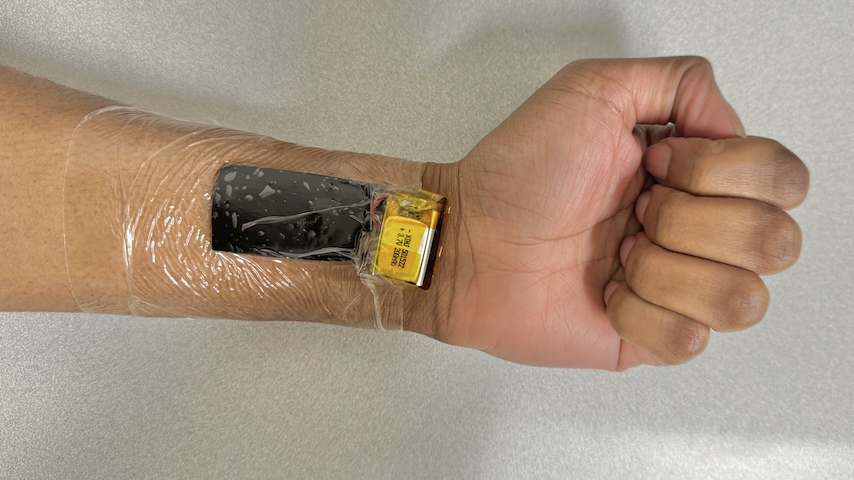
Existing pulse oximetry level sensors can get confused when a person’s skin has more melanin. A new sensor is changing that.
Accurate photoplethysmography (PPG) signals are critical to gain insight into blood oxygen levels, measuring cardiovascular health like heart rate, heart rate variability, and perfusion index (PI).
However, a study by Johns Hopkins University, “Racial and Ethnic Discrepancy in Pulse Oximetry and Delayed Identification of Treatment Eligibility Among Patients With COVID-19,” found overestimated pulse oximetry levels for people with more melanin in their skin.
“It has long been recognized that pulse oximeters tend to overestimate oxygen saturation levels in individuals with darker skin tones. This disparity gained heightened attention during the COVID-19 pandemic, when the use of pulse oximeters increased dramatically in both clinical and at-home settings,” said Rutendo Jakachira, a physics doctoral candidate and Google doctoral fellow in Brown University’s Department of Physics. “Our research investigates whether these inaccuracies can be addressed upstream, prior to the traditional calibration stage that typically requires desaturation studies. Specifically, we are exploring whether leveraging polarization can enhance the quality of photoplethysmographic signals, which form the basis for estimating blood oxygen saturation.”
PPG sensors, used in devices like heart rate monitors, sleep and wellness wearables, and pulse oximeters, work by shining light into the skin and measuring changes in the light that is either reflected back or transmitted through tissue. As the heart beats, arterial blood volume rises and falls, which changes how much light is absorbed. Those periodic changes are captured as a PPG waveform.
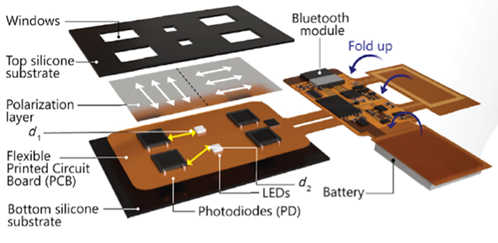 Exploded schematic of the device architecture, comprising a multilayer stack with top and bottom silicone substrates, a polarization layer, fPCB, LEDs, and PDs. The windowed top layer aligns with optoelectronic components to allow light transmission. Image: Brown University
Pulse oximeters build on this principle by using two wavelengths of light, typically red and infrared. Because oxygenated and deoxygenated hemoglobin absorb these wavelengths differently, the device can estimate blood oxygen saturation by analyzing the relative absorption at each wavelength using a calibration curve. The calibration curve maps the absorption ratios at these two wavelengths against arterial blood gas (ABG) measurements.
Exploded schematic of the device architecture, comprising a multilayer stack with top and bottom silicone substrates, a polarization layer, fPCB, LEDs, and PDs. The windowed top layer aligns with optoelectronic components to allow light transmission. Image: Brown University
Pulse oximeters build on this principle by using two wavelengths of light, typically red and infrared. Because oxygenated and deoxygenated hemoglobin absorb these wavelengths differently, the device can estimate blood oxygen saturation by analyzing the relative absorption at each wavelength using a calibration curve. The calibration curve maps the absorption ratios at these two wavelengths against arterial blood gas (ABG) measurements.
Darker skin contains more melanin, which absorbs and scatters light more, often leading to less reliable readings. This disparity has been linked to inaccuracies in blood oxygen measurements among people with more melanin in their skin, which can lead to delayed or unrecognized need for health therapies.
Through polarization gating (PG), the device separates the detected red and infrared light according to its polarization state. The sensor resolves the returning light into two channels: One measures light that retains the incident polarization state (co-polarized), and another measures light with a changed polarization state (cross-polarized).
Because changes in polarization arise from scattering in tissue, the separation provides depth-sensitive information. Light that maintains its original polarization state is more strongly associated with superficial tissue interactions, while light detected in the orthogonal polarization state is more likely to have undergone multiple scattering events and therefore carries information from deeper vascular layers.
By leveraging this distinction, PG helps attenuate contributions from the melanin-rich epidermis and enhances sensitivity to signals originating from deeper blood vessels.
In 2024, a research engineer well-versed in wearable devices taught the team how to create a wearable sensor, which opened the door to using the technology in a much smaller and more flexible way.
While the wearable PPG sensor shows the potential to more accurately and equitably measure blood oxygen levels in health care settings, the team is waiting for additional funding that would enable the next step in testing, which is calibration. Calibration is important because it sets up a baseline against which health care professionals can compare individual measurements.
“Preliminary results are promising, and we are preparing to test our devices on a larger cohort size. My hope is that this technique will be adopted in pulse oximeters, ultimately enabling earlier detection of hypoxemia, reducing misdiagnosis and supporting more appropriate oxygen administration,” said Jakachira, who joined the research team during her first year as a doctoral student at Brown University and is now developing the work as the foundation of her doctoral thesis. “Improving measurement accuracy could also strengthen triage decisions in the emergency room and ICU, as well as during high-demand situations such as the COVID-19 pandemic, particularly for patients of color, who have historically been at greater risk of inaccurate readings.”
As the team waits for funding that would facilitate calibration and allow the tech to be leveraged in health care settings, they’re optimizing the device. Researchers currently are working to determine whether they can enhance the signal’s PI.
“We’re enhancing the signal quality metrics for the PPG signals and then ultimately would like to do a calibration study to have a definitive answer on how our SpO2 (blood oxygen saturation) value map compares to the gold standard across different skin tones,” Jakachira said.
In addition to calibration, future plans include exploring measurements at different anatomical sites and incorporating the unpolarized condition on the same wearable as the polarized conditions, according to the research paper.
Jessica Porter is an independent writer in New York.
However, a study by Johns Hopkins University, “Racial and Ethnic Discrepancy in Pulse Oximetry and Delayed Identification of Treatment Eligibility Among Patients With COVID-19,” found overestimated pulse oximetry levels for people with more melanin in their skin.
“It has long been recognized that pulse oximeters tend to overestimate oxygen saturation levels in individuals with darker skin tones. This disparity gained heightened attention during the COVID-19 pandemic, when the use of pulse oximeters increased dramatically in both clinical and at-home settings,” said Rutendo Jakachira, a physics doctoral candidate and Google doctoral fellow in Brown University’s Department of Physics. “Our research investigates whether these inaccuracies can be addressed upstream, prior to the traditional calibration stage that typically requires desaturation studies. Specifically, we are exploring whether leveraging polarization can enhance the quality of photoplethysmographic signals, which form the basis for estimating blood oxygen saturation.”
PPG sensors, used in devices like heart rate monitors, sleep and wellness wearables, and pulse oximeters, work by shining light into the skin and measuring changes in the light that is either reflected back or transmitted through tissue. As the heart beats, arterial blood volume rises and falls, which changes how much light is absorbed. Those periodic changes are captured as a PPG waveform.
Exploded schematic of the device architecture, comprising a multilayer stack with top and bottom silicone substrates, a polarization layer, fPCB, LEDs, and PDs. The windowed top layer aligns with optoelectronic components to allow light transmission. Image: Brown University
Darker skin contains more melanin, which absorbs and scatters light more, often leading to less reliable readings. This disparity has been linked to inaccuracies in blood oxygen measurements among people with more melanin in their skin, which can lead to delayed or unrecognized need for health therapies.
Research improves PPG signals
In 2021, a research group from Brown University began developing a more accurate tool to measure blood oxygen levels for people with darker skin. They created a flexible, wireless, dual-wavelength, wearable PPG that can measure the PI, which indicates pulse strength, across various skin tones, according to the team’s research paper, “Evaluation of a polarization-sensitive, dual-wavelength wearable photoplethysmography sensor across a range of skin tones.”Through polarization gating (PG), the device separates the detected red and infrared light according to its polarization state. The sensor resolves the returning light into two channels: One measures light that retains the incident polarization state (co-polarized), and another measures light with a changed polarization state (cross-polarized).
Because changes in polarization arise from scattering in tissue, the separation provides depth-sensitive information. Light that maintains its original polarization state is more strongly associated with superficial tissue interactions, while light detected in the orthogonal polarization state is more likely to have undergone multiple scattering events and therefore carries information from deeper vascular layers.
By leveraging this distinction, PG helps attenuate contributions from the melanin-rich epidermis and enhances sensitivity to signals originating from deeper blood vessels.
Next steps for PPG research
The first iteration of the sensor was a large, benchtop tool that allowed researchers to test theories by trying many components. Once they discovered the technology that worked, the team created a portable device the size of a shoebox that could be used in a hospital setting. Despite its smaller size, the device was still too large for an ICU setting, so researchers began seeking ways to further decrease its size.In 2024, a research engineer well-versed in wearable devices taught the team how to create a wearable sensor, which opened the door to using the technology in a much smaller and more flexible way.
While the wearable PPG sensor shows the potential to more accurately and equitably measure blood oxygen levels in health care settings, the team is waiting for additional funding that would enable the next step in testing, which is calibration. Calibration is important because it sets up a baseline against which health care professionals can compare individual measurements.
“Preliminary results are promising, and we are preparing to test our devices on a larger cohort size. My hope is that this technique will be adopted in pulse oximeters, ultimately enabling earlier detection of hypoxemia, reducing misdiagnosis and supporting more appropriate oxygen administration,” said Jakachira, who joined the research team during her first year as a doctoral student at Brown University and is now developing the work as the foundation of her doctoral thesis. “Improving measurement accuracy could also strengthen triage decisions in the emergency room and ICU, as well as during high-demand situations such as the COVID-19 pandemic, particularly for patients of color, who have historically been at greater risk of inaccurate readings.”
As the team waits for funding that would facilitate calibration and allow the tech to be leveraged in health care settings, they’re optimizing the device. Researchers currently are working to determine whether they can enhance the signal’s PI.
“We’re enhancing the signal quality metrics for the PPG signals and then ultimately would like to do a calibration study to have a definitive answer on how our SpO2 (blood oxygen saturation) value map compares to the gold standard across different skin tones,” Jakachira said.
In addition to calibration, future plans include exploring measurements at different anatomical sites and incorporating the unpolarized condition on the same wearable as the polarized conditions, according to the research paper.
Jessica Porter is an independent writer in New York.
Existing pulse oximetry level sensors can get confused when a person’s skin has more melanin. A new sensor is changing that.

Freelance writer in New York
Related Content


Jun 25, 2026
A Mighty Wind Project

You probably don’t know how much you fart. And turns out, nobody else does either. Researchers at the University of Maryland have created a tool to finally answer this vital question.

Jun 22, 2026
Blaze-Battling Bots Ahead


A novel system that uses AI-powered robots to extinguish fires could eliminate the need to put firefighters in dangerous situations.
Jun 16, 2026
Single Chip Combines Memory and Computation

A hardware advancement takes inspiration from the human brain’s neural network.


Jun 12, 2026
Quiz: A Trolley’s Trucks and Frogs
Although streetcars are more of a novelty these days, innovative engineering made them possible. See what you know with this ASME quiz.