Paper Mills Have a Path to Net Zero, Researchers Say
Paper Mills Have a Path to Net Zero, Researchers Say
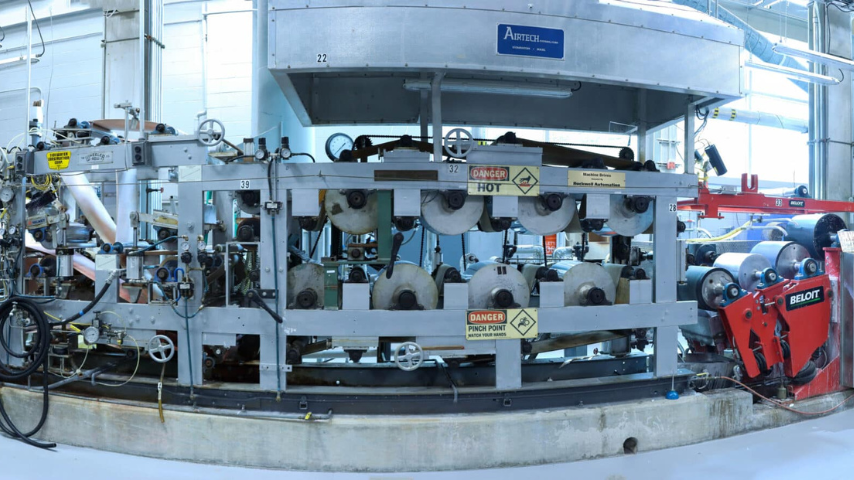
New NCSU research outlines how electrification and efficiency improvements could help paper mills reach net-zero emissions.
Paper production accounts for approximately 5 percent of global industrial energy consumption. The rate rises to 6 percent within the U.S., which, as the second largest paper producer, churns out 70 to 75 million metric tons of paper annually. China leads with an annual 400 million metric tons, approximately.
Even in the midst of the digital information age, paper production continues to grow. A 4 percent bump in production in 2021 has flattened out in recent years, but production is still expected to increase 1 percent annually by 2030, according to the IEA.
Paper is ingrained in our lives, said Lokendra Pal, a professor in North Carolina State University’s Department of Forest Biomaterials and the Department of Mechanical & Aerospace Engineering. Pal is also the co-author of recently published research out of NCSU that aims to help paper mills reduce their impact on the environment.
“This is the largest bio-based industry,” Pal said. It’s a product that nearly everyone experiences “every day, once you wake up in the morning,” from hygiene products to packaging. And as traditional uses such as newsprint fade from demand, new uses arise.
“Look at all the different forms, factors, colors; there’s so much,” Pal said of the estimated 28,000 different types of paper currently in production. And the paper industry has some of the top recycling rates versus other similar-use materials such as plastic, typically ranging from 60 to 70 percent.
Discover the Benefits of ASME Membership
The research provides paper mill operators with strategies to further reduce their environmental impacts during production and operations, showing that even net zero is achievable—if the stars align.
The research considers the entire life cycle of paper production by comparing results across four different primary types of mills. Evaluating the data through the lens of the different mill operations provides decarbonization pathways that can be tailored to each mill configuration. “If you look at the big picture, there is a pathway” to net zero, Pal said.
Three key strategies outlined in the work include energy-efficiency improvements, particularly dewatering to reduce energy-intensive drying demands, along with electrification and the use of low-carbon fuels.
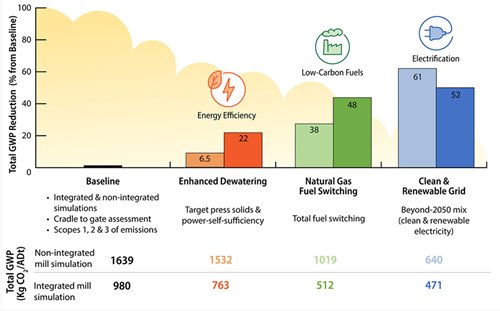 The study compares how energy efficiency, low-carbon fuels, and electrification could reduce emissions across different types of paper mills. Image: González et al., Journal of Cleaner Production
Published in the Journal of Cleaner Production, the five-year research effort used simulations to compare data from operations of four main types of mill operations. The first level is whether a mill is a virgin or recycled fiber mill. Virgin mills use virgin wood to create pulp/paper, and recycled fiber mills make paper products out of existing fibers that may have already been processed. Next is whether the mills are integrated or not. A virgin mill is considered integrated if it produces its own energy using waste wood sourced on site, typically accounting for 85 to 90 percent of its needs (natural gas boilers typically support the rest). Virgin integrated mills also use a closed-loop system, recycling wood byproducts, glues, and associated chemicals. Non-integrated mills typically rely on the grid for energy, supported by fossil fuels.
The study compares how energy efficiency, low-carbon fuels, and electrification could reduce emissions across different types of paper mills. Image: González et al., Journal of Cleaner Production
Published in the Journal of Cleaner Production, the five-year research effort used simulations to compare data from operations of four main types of mill operations. The first level is whether a mill is a virgin or recycled fiber mill. Virgin mills use virgin wood to create pulp/paper, and recycled fiber mills make paper products out of existing fibers that may have already been processed. Next is whether the mills are integrated or not. A virgin mill is considered integrated if it produces its own energy using waste wood sourced on site, typically accounting for 85 to 90 percent of its needs (natural gas boilers typically support the rest). Virgin integrated mills also use a closed-loop system, recycling wood byproducts, glues, and associated chemicals. Non-integrated mills typically rely on the grid for energy, supported by fossil fuels.
Simulation helped inform the tradeoffs of changing a process or employing different energy strategies across the different mill types. Some components, such as the amount of renewable energy supplied to the grid, may not be under control of the mill operator. But some mills may be able to implement changes directly, such as switching to electric-powered boilers, which the research shows could reduce emissions up to 61 percent.
Another focus of the research included the “deglueing” process and recovering the lignin removed during the pulping process to use as an energy source. “There’s a lot of calorific value,” Pal said, noting it can be particularly effective for the energy-intensive drying and heating processes. In addition to recycling the lignin, recycling efforts also typically recover 95 to 97 percent of the chemicals used during the processing, according to Pal.
Other opportunities to improve energy efficiency may come from upgrading equipment, especially within the U.S., where many mills rely on decades-old machinery. China’s paper production has shifted away from its historically small mills to much larger mills with modern equipment. Pal shared that modernizing equipment could help lead to scenarios where “you can not only power your own mill, but you can send that electricity back to the grid.”
 Pal’s paper industry background informed his academic career, helping provide him with a big picture perspective. He started out managing production at a paper mill for nearly five years before returning to earn his Ph.D. in Paper and Imaging Science and Engineering from Western Michigan University. After professional stints at Hewlett-Packard and International Paper where he helped develop patented technologies, Pal fulfilled a lifelong dream to teach when he joined NCSU.
And he still gets to manage a paper plant: NCSU’s Smart Manufacturing Innovation Center includes a pilot paper plant that is key to research and raises the visibility of NCSU’s program “as the MIT of paper science engineering,” Pal said.
Ongoing research is exploring the impacts of adding more sensors to the machinery, feeding into AI to automate data analytics for real-time insights and dashboarding. “What we’re trying to build is like a digital lab that can simulate a lot of scenarios,” Pal said. This includes digital twin simulation, finite element analysis, and interdisciplinary approaches.
Key to the success of these efforts is the collaboration with multiple agencies, said Pal, including the U.S. Department of Energy, private industry, and interdisciplinary work across mechanical, aerospace, and computer science engineering. “It’s a community,” he said.
Nancy Kristof is a technology writer in Denver.
Even in the midst of the digital information age, paper production continues to grow. A 4 percent bump in production in 2021 has flattened out in recent years, but production is still expected to increase 1 percent annually by 2030, according to the IEA.
Paper is ingrained in our lives, said Lokendra Pal, a professor in North Carolina State University’s Department of Forest Biomaterials and the Department of Mechanical & Aerospace Engineering. Pal is also the co-author of recently published research out of NCSU that aims to help paper mills reduce their impact on the environment.
“This is the largest bio-based industry,” Pal said. It’s a product that nearly everyone experiences “every day, once you wake up in the morning,” from hygiene products to packaging. And as traditional uses such as newsprint fade from demand, new uses arise.
“Look at all the different forms, factors, colors; there’s so much,” Pal said of the estimated 28,000 different types of paper currently in production. And the paper industry has some of the top recycling rates versus other similar-use materials such as plastic, typically ranging from 60 to 70 percent.
Discover the Benefits of ASME Membership
The research provides paper mill operators with strategies to further reduce their environmental impacts during production and operations, showing that even net zero is achievable—if the stars align.
The research considers the entire life cycle of paper production by comparing results across four different primary types of mills. Evaluating the data through the lens of the different mill operations provides decarbonization pathways that can be tailored to each mill configuration. “If you look at the big picture, there is a pathway” to net zero, Pal said.
Three key strategies outlined in the work include energy-efficiency improvements, particularly dewatering to reduce energy-intensive drying demands, along with electrification and the use of low-carbon fuels.
The study compares how energy efficiency, low-carbon fuels, and electrification could reduce emissions across different types of paper mills. Image: González et al., Journal of Cleaner Production
Simulation helped inform the tradeoffs of changing a process or employing different energy strategies across the different mill types. Some components, such as the amount of renewable energy supplied to the grid, may not be under control of the mill operator. But some mills may be able to implement changes directly, such as switching to electric-powered boilers, which the research shows could reduce emissions up to 61 percent.
Another focus of the research included the “deglueing” process and recovering the lignin removed during the pulping process to use as an energy source. “There’s a lot of calorific value,” Pal said, noting it can be particularly effective for the energy-intensive drying and heating processes. In addition to recycling the lignin, recycling efforts also typically recover 95 to 97 percent of the chemicals used during the processing, according to Pal.
Other opportunities to improve energy efficiency may come from upgrading equipment, especially within the U.S., where many mills rely on decades-old machinery. China’s paper production has shifted away from its historically small mills to much larger mills with modern equipment. Pal shared that modernizing equipment could help lead to scenarios where “you can not only power your own mill, but you can send that electricity back to the grid.”
The Age of Electricity Advances
As the world’s connectivity and automation needs increase, the need for more electricity is escalating as well.
And he still gets to manage a paper plant: NCSU’s Smart Manufacturing Innovation Center includes a pilot paper plant that is key to research and raises the visibility of NCSU’s program “as the MIT of paper science engineering,” Pal said.
Ongoing research is exploring the impacts of adding more sensors to the machinery, feeding into AI to automate data analytics for real-time insights and dashboarding. “What we’re trying to build is like a digital lab that can simulate a lot of scenarios,” Pal said. This includes digital twin simulation, finite element analysis, and interdisciplinary approaches.
Key to the success of these efforts is the collaboration with multiple agencies, said Pal, including the U.S. Department of Energy, private industry, and interdisciplinary work across mechanical, aerospace, and computer science engineering. “It’s a community,” he said.
Nancy Kristof is a technology writer in Denver.


As renewable energy gains momentum, oil and natural gas continue to remain primary global energy sources. This collection delves into latest digital trends enabling breakthroughs in energy transformation.