The Birth of Practical Aviation
The Birth of Practical Aviation
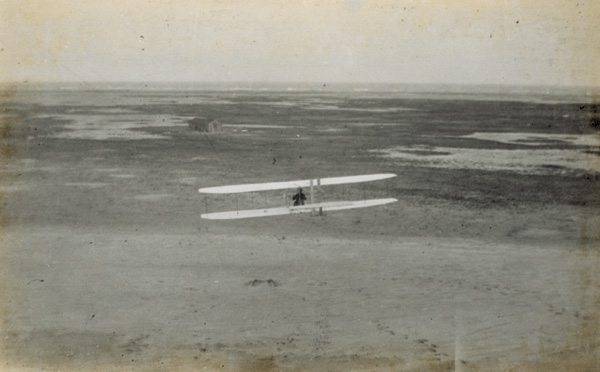
The seconds-long flight at Kitty Hawk was not the Wright brothers’ most impressive accomplishment.
History likes big firsts. Put a person on the moon, split the first atom, run a mile under four minutes, and that’s what most people are going to remember. Never mind all the hard work, brilliance, and breakthroughs that come after. So, when most people think of the Wright brothers—if we may speak, momentarily, for most people—they think of the 12-second flight at Kitty Hawk, on Dec. 17, 1903, and the plane that did it.
Indeed, that flight, and the three that followed that day—the longest of which lasted for 59 seconds and covered 852 feet—is as good a marking of the birth of aviation as any other. But the perseverance, ingenuity, and even derring-do, that the Wrights exhibited in building a plane with real maneuverability and sustainable flight is what makes the Wright Flyer III worthy of its designation as an ASME Historic Mechanical Engineering Landmark.
“The Kitty Hawk airplane is so important—it’s proof of concept that an aircraft can take off under its own power,” said Alex Heckman, vice president of museum operations at Carillon Historical Park, which has the 1905 Wright Flyer III on display. “But that very historic airplane flew just four times on that one incredibly historic day. It took them the better part of the next two years to perfect their aircraft and really make it something that would be marketable and truly a practical flying machine.”
The younger brother, Orville, remembered that in high school, his botany professor had taken his class out to a prairie and cow pasture to examine the vegetation there. It happened to be just a few miles from where the Wrights lived, so they asked the owner, banker Torrance Huffman, if they could use it for their flying experiments. He agreed on the condition that they round up the cattle and horses there before doing any flying overhead.
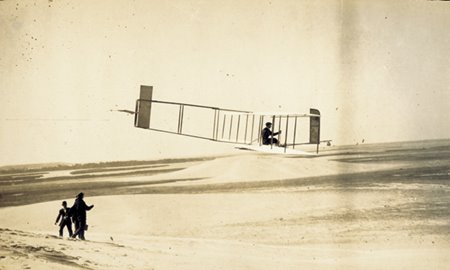 Alexander Ogilvie gliding in the Wright 1911 glider with three men watching from a sand dune. Photo: Wright Brothers Collection
Now, with a field eight miles from their home, they got to work building what is now known as the Wright Flyer II, and in 1904, they made 105 flights in the new plane, the longest of which was just more than five minutes—nothing to be ashamed of in the history of aviation, but not the sustained flight for which they were aiming. The brothers were having some of the same problems that they had experienced with the first plane at Kitty Hawk: it was too sensitive to pitch control. Minute adjustments sent the plane flying wildly up and down.
Alexander Ogilvie gliding in the Wright 1911 glider with three men watching from a sand dune. Photo: Wright Brothers Collection
Now, with a field eight miles from their home, they got to work building what is now known as the Wright Flyer II, and in 1904, they made 105 flights in the new plane, the longest of which was just more than five minutes—nothing to be ashamed of in the history of aviation, but not the sustained flight for which they were aiming. The brothers were having some of the same problems that they had experienced with the first plane at Kitty Hawk: it was too sensitive to pitch control. Minute adjustments sent the plane flying wildly up and down.
So, they set out to build a longer and taller plane, this time with the front elevator surfaces four and a half feet further from the wings for extra stability, and an improved engine with larger cylinders. They started setting up the new plane in May 1905 and on June 23, it made its first flight, which lasted just under 10 seconds.
However, it proved to be as unstable as its predecessors and in July, it crashed with Orville at the controls. He emerged unharmed, but they knew that they had to radically overhaul the design.
They moved the rudder and the elevator farther from the main wings and added two vanes between the surface areas of the elevator. They also bent the tips of the propellers (hand carved, as always). And, most importantly, the controls for roll and yaw were decoupled.
“So, for the first time, they could independently control pitch, roll and yaw,” Heckman said. “And that really was a breakthrough for them and allowed them to make leaps and bounds with how they were able to control the plane and develop the plane.”
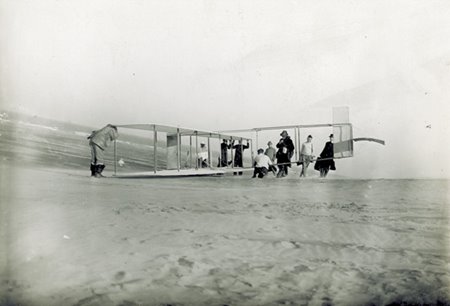 A group of men preparing the Wright 1911 Glider for launch. Photo: Wright Brothers Collection
In the previous planes, the pilot, lying prone in a hip cradle, pulled wires that warped the wings—essentially steering by shifting his weight, bicycle style. That same motion moved the rudder, controlling the yaw at the same time. Now, with the Wright Flyer III, a vertical stick allowed the pilot to control the elevators with his left hand, while his right worked a paddle to adjust the rudder. The wings were still warped when the pilot shifted his weight.
A group of men preparing the Wright 1911 Glider for launch. Photo: Wright Brothers Collection
In the previous planes, the pilot, lying prone in a hip cradle, pulled wires that warped the wings—essentially steering by shifting his weight, bicycle style. That same motion moved the rudder, controlling the yaw at the same time. Now, with the Wright Flyer III, a vertical stick allowed the pilot to control the elevators with his left hand, while his right worked a paddle to adjust the rudder. The wings were still warped when the pilot shifted his weight.
By the end of August, the Wrights were able to fly the revamped plane with the new control system. The first attempt lasted a mere 10 seconds, but, true to their methodical nature, they tweaked the plane bit by bit, extending flight times and were soon regularly breaking records.
Just a week after that first flight, Orville managed to take several tours of their field, keeping the plane aloft for nearly five minutes, and landing at the same spot he’d taken off from. And on Sept. 7, they made another first in aviation history by hitting a bird in flight for the first time. On Sept. 26, Wilbur flew for more than 18 minutes—a flight that would have gone on for longer, but he ran out of fuel.
Finally, on Oct. 5, Wilbur took off, made a loop of the field, and then made another loop of the field, and then another, and he kept going, round and round, making nearly 30 laps until he ran out of fuel. The flight lasted for 39.5 minutes, and he covered 24 miles. This flight proved to the brothers that they had a practical, marketable flying machine.
Charles Billman, a toddler at the time, was another spectator. Soon after witnessing this flight, he became the first child in recorded history to stretch out his arms to either side and make buzzing sounds to pretend to be a plane.
Indeed, from almost any perspective, the day was an absolute triumph for the Wrights.
“I think, for most people, they would go and shout it from the rooftops and get as big of a crowd as they could get to witness their achievement. They could have sold tickets,” Heckman said. “But they do what I think is amazing, especially in the day and age that we live in now. They had the self-restraint to put this airplane into hiding for two and a half years. They don’t make any flights at all in 1906 or 1907.”
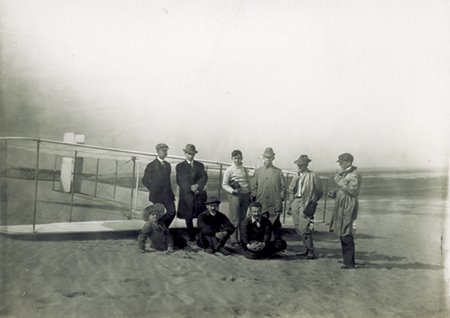 Group photograph with the Wright 1911 Glider. Seated from left: Horace Wright, Orville Wright, and Alexander Ogilvie. Standing from left: Lorin Wright, Van Ness Harwood, not identified, Arnold Krockman, not identified, and John Mitchell. Photo: Wright Brothers Collection
The idea was to keep prying eyes from visually reverse engineering the plane and beating them at their own game. And, in fact, by 1908, they had two contracts to build planes, one with the U.S. Army Signal Corps, and another with France’s La Compagnie Generale de Navigation Aérienne. To fulfill these agreements, they had to demonstrate their plane’s abilities. So, they shipped the mothballed Wright Flyer III to Kitty Hawk in the spring of that year.
Group photograph with the Wright 1911 Glider. Seated from left: Horace Wright, Orville Wright, and Alexander Ogilvie. Standing from left: Lorin Wright, Van Ness Harwood, not identified, Arnold Krockman, not identified, and John Mitchell. Photo: Wright Brothers Collection
The idea was to keep prying eyes from visually reverse engineering the plane and beating them at their own game. And, in fact, by 1908, they had two contracts to build planes, one with the U.S. Army Signal Corps, and another with France’s La Compagnie Generale de Navigation Aérienne. To fulfill these agreements, they had to demonstrate their plane’s abilities. So, they shipped the mothballed Wright Flyer III to Kitty Hawk in the spring of that year.
They used the same frame, but made a few modifications, including a new four-cylinder, 35-horsepower engine. The plane also had to seat both a pilot and a passenger, per Army requirements, so the pilot would now sit upright with the controls to his side.
Orville made the first flight of 1908 on May 6. A week later, a mechanic named Charlie Furnas showed up, eager to go for a ride. As they had to prove they could take a passenger, Wilbur took him for a jaunt in the air, making Furnas the first passenger on an airplane.
Not long after that flight, Wilbur lost control of the plane, due to a change they’d made in the elevator controls, and slammed into a sand dune at 40 mph. He emerged with only superficial injuries, but the plane was destroyed. It had made its last flight.
However, it was not the end of the story for the Wright Flyer III.
Crane sent workers to pack up Wright Flyer III’s remains and ship them, and a 1911 glider, to Massachusetts. But when it came time to assemble the glider, Crane’s workers put it together according to their whims or misunderstandings, without supervision from Orville. “It was a total hatchet job,” Heckman said. “I mean, they basically destroyed the 1911 glider in the process. Orville was so upset about it that he told them that he then wouldn’t have anything to do with helping them.”
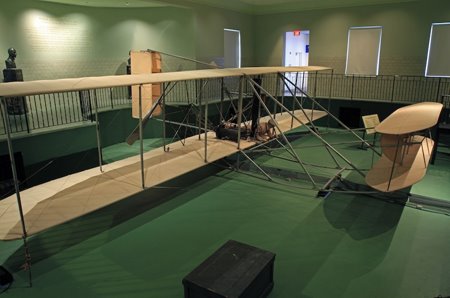 The Wright Flyer III in its current home at Carillon Historical Park. Photo: Carillon Historical Park
Then, 25 years later, Orville’s friend, Colonel Edward Deeds, chair of Dayton’s National Cash Register Company—the city’s largest employer at the time—decided he wanted to start a museum in Dayton, where it all happened. So, Orville sheepishly reached out to the museum in Pittsfield, which, thankfully, had changed its focus to Natural History, and they relinquished the plane without a fuss.
The Wright Flyer III in its current home at Carillon Historical Park. Photo: Carillon Historical Park
Then, 25 years later, Orville’s friend, Colonel Edward Deeds, chair of Dayton’s National Cash Register Company—the city’s largest employer at the time—decided he wanted to start a museum in Dayton, where it all happened. So, Orville sheepishly reached out to the museum in Pittsfield, which, thankfully, had changed its focus to Natural History, and they relinquished the plane without a fuss.
Orville still had the expensive parts: the propellers, the chains, the chain guides, and the engine. The head of NCR’s patent department, Carl Beust, devised a scheme to reclaim some of the pieces that the souvenir hunters had made off with after the crash in 1908. He offered a swatch of fabric from the Kitty Hawk plane, a piece of wood from the plane, and an authenticating letter from Orville—all in a Lucite box—in exchange for the looted bits.
That plan worked, and much of the plane came back to Dayton (and, in fact, the museum still has many of the boxes and will honor the deal if anyone out there happens to have a piece of the Wright Flyer III in their attic). As a result of these efforts, around 70 percent of the plane on exhibit at the Carillon Historical Park is original—that’s more than any other Wright brothers craft, including the 1903 Kitty Hawk plane at the Smithsonian.
Orville helped restore the plane and design how it would be displayed. It is not, for instance, hanging from the ceiling. “Orville had the idea of having the airplane sitting in a recessed pit,” Heckman said. “It’s about four-and-a-half feet below where people are standing, so you can really look down at it, and you can walk around the entirety of the plane and get a sense of how it was built.”
Unfortunately, Orville died before he had a chance to see visitors gazing at the Wright Flyer III, just a year and a half before the museum opened. (Wilbur died of typhoid fever in 1912.) But for 75 years now, early flight enthusiasts have been able to see the plane that made aviation practical in Dayton, Ohio.
Michael Abrams is a technology writer in Westfield, N.J.
Indeed, that flight, and the three that followed that day—the longest of which lasted for 59 seconds and covered 852 feet—is as good a marking of the birth of aviation as any other. But the perseverance, ingenuity, and even derring-do, that the Wrights exhibited in building a plane with real maneuverability and sustainable flight is what makes the Wright Flyer III worthy of its designation as an ASME Historic Mechanical Engineering Landmark.
“The Kitty Hawk airplane is so important—it’s proof of concept that an aircraft can take off under its own power,” said Alex Heckman, vice president of museum operations at Carillon Historical Park, which has the 1905 Wright Flyer III on display. “But that very historic airplane flew just four times on that one incredibly historic day. It took them the better part of the next two years to perfect their aircraft and really make it something that would be marketable and truly a practical flying machine.”
Flight’s evolution
That machine made its arguably more groundbreaking flights far from the sands and winds of Kitty Hawk. Shipping planes to North Carolina’s barrier islands, to say nothing of journeying there themselves, took time and effort, so the Wrights wanted to continue their work closer to home, in Dayton, Ohio.The younger brother, Orville, remembered that in high school, his botany professor had taken his class out to a prairie and cow pasture to examine the vegetation there. It happened to be just a few miles from where the Wrights lived, so they asked the owner, banker Torrance Huffman, if they could use it for their flying experiments. He agreed on the condition that they round up the cattle and horses there before doing any flying overhead.
Alexander Ogilvie gliding in the Wright 1911 glider with three men watching from a sand dune. Photo: Wright Brothers Collection
So, they set out to build a longer and taller plane, this time with the front elevator surfaces four and a half feet further from the wings for extra stability, and an improved engine with larger cylinders. They started setting up the new plane in May 1905 and on June 23, it made its first flight, which lasted just under 10 seconds.
However, it proved to be as unstable as its predecessors and in July, it crashed with Orville at the controls. He emerged unharmed, but they knew that they had to radically overhaul the design.
They moved the rudder and the elevator farther from the main wings and added two vanes between the surface areas of the elevator. They also bent the tips of the propellers (hand carved, as always). And, most importantly, the controls for roll and yaw were decoupled.
“So, for the first time, they could independently control pitch, roll and yaw,” Heckman said. “And that really was a breakthrough for them and allowed them to make leaps and bounds with how they were able to control the plane and develop the plane.”
A group of men preparing the Wright 1911 Glider for launch. Photo: Wright Brothers Collection
By the end of August, the Wrights were able to fly the revamped plane with the new control system. The first attempt lasted a mere 10 seconds, but, true to their methodical nature, they tweaked the plane bit by bit, extending flight times and were soon regularly breaking records.
Just a week after that first flight, Orville managed to take several tours of their field, keeping the plane aloft for nearly five minutes, and landing at the same spot he’d taken off from. And on Sept. 7, they made another first in aviation history by hitting a bird in flight for the first time. On Sept. 26, Wilbur flew for more than 18 minutes—a flight that would have gone on for longer, but he ran out of fuel.
Finally, on Oct. 5, Wilbur took off, made a loop of the field, and then made another loop of the field, and then another, and he kept going, round and round, making nearly 30 laps until he ran out of fuel. The flight lasted for 39.5 minutes, and he covered 24 miles. This flight proved to the brothers that they had a practical, marketable flying machine.
Advancing flight
The Wrights felt confident enough in their plane on that day—and the two previous—to invite onlookers. Here’s how a reporter from Gleanings in Bee Culture described it:When it first turned that circle, and came near the starting-point, I was right in front of it; and I said then, and I believe still, it was one of the grandest sights, if not the grandest sight, of my life. Imagine a locomotive that has left its track, and is climbing up in the air right toward you―a locomotive without any wheels, we will say, but with white wings instead, we will further say―a locomotive made of aluminum. Well, now, imagine this white locomotive, with wings that spread 20 feet each way, coming right toward you with a tremendous flap of its propellers, and you will have something like what I saw.
Charles Billman, a toddler at the time, was another spectator. Soon after witnessing this flight, he became the first child in recorded history to stretch out his arms to either side and make buzzing sounds to pretend to be a plane.
Indeed, from almost any perspective, the day was an absolute triumph for the Wrights.
“I think, for most people, they would go and shout it from the rooftops and get as big of a crowd as they could get to witness their achievement. They could have sold tickets,” Heckman said. “But they do what I think is amazing, especially in the day and age that we live in now. They had the self-restraint to put this airplane into hiding for two and a half years. They don’t make any flights at all in 1906 or 1907.”
Group photograph with the Wright 1911 Glider. Seated from left: Horace Wright, Orville Wright, and Alexander Ogilvie. Standing from left: Lorin Wright, Van Ness Harwood, not identified, Arnold Krockman, not identified, and John Mitchell. Photo: Wright Brothers Collection
They used the same frame, but made a few modifications, including a new four-cylinder, 35-horsepower engine. The plane also had to seat both a pilot and a passenger, per Army requirements, so the pilot would now sit upright with the controls to his side.
Orville made the first flight of 1908 on May 6. A week later, a mechanic named Charlie Furnas showed up, eager to go for a ride. As they had to prove they could take a passenger, Wilbur took him for a jaunt in the air, making Furnas the first passenger on an airplane.
Not long after that flight, Wilbur lost control of the plane, due to a change they’d made in the elevator controls, and slammed into a sand dune at 40 mph. He emerged with only superficial injuries, but the plane was destroyed. It had made its last flight.
However, it was not the end of the story for the Wright Flyer III.
History recovered
The plane was instantly recognized as having value and souvenir hunters made off with a good deal of the flyer. In 1911, an industrialist from Massachusetts, Zenas Crane, contacted Orville, hoping to bring what remained of the plane to Pittsfield for a museum he had started. Orville gave him permission to go to Kitty Hawk, gather whatever he found there, and display the reconstituted plane in the museum.Crane sent workers to pack up Wright Flyer III’s remains and ship them, and a 1911 glider, to Massachusetts. But when it came time to assemble the glider, Crane’s workers put it together according to their whims or misunderstandings, without supervision from Orville. “It was a total hatchet job,” Heckman said. “I mean, they basically destroyed the 1911 glider in the process. Orville was so upset about it that he told them that he then wouldn’t have anything to do with helping them.”
The Wright Flyer III in its current home at Carillon Historical Park. Photo: Carillon Historical Park
Orville still had the expensive parts: the propellers, the chains, the chain guides, and the engine. The head of NCR’s patent department, Carl Beust, devised a scheme to reclaim some of the pieces that the souvenir hunters had made off with after the crash in 1908. He offered a swatch of fabric from the Kitty Hawk plane, a piece of wood from the plane, and an authenticating letter from Orville—all in a Lucite box—in exchange for the looted bits.
That plan worked, and much of the plane came back to Dayton (and, in fact, the museum still has many of the boxes and will honor the deal if anyone out there happens to have a piece of the Wright Flyer III in their attic). As a result of these efforts, around 70 percent of the plane on exhibit at the Carillon Historical Park is original—that’s more than any other Wright brothers craft, including the 1903 Kitty Hawk plane at the Smithsonian.
Orville helped restore the plane and design how it would be displayed. It is not, for instance, hanging from the ceiling. “Orville had the idea of having the airplane sitting in a recessed pit,” Heckman said. “It’s about four-and-a-half feet below where people are standing, so you can really look down at it, and you can walk around the entirety of the plane and get a sense of how it was built.”
Unfortunately, Orville died before he had a chance to see visitors gazing at the Wright Flyer III, just a year and a half before the museum opened. (Wilbur died of typhoid fever in 1912.) But for 75 years now, early flight enthusiasts have been able to see the plane that made aviation practical in Dayton, Ohio.
Michael Abrams is a technology writer in Westfield, N.J.
The seconds-long flight at Kitty Hawk was not the Wright brothers’ most impressive accomplishment.

Freelance writer based in New Jersey
Related Content

May 1, 2026
Quiz: Space Exploration Beyond the Moon

Artemis II has brought new excitement about the Moon, but there are plenty of missions that have gone farther.
Feb 27, 2026
Quiz: Crawling to Space
Test your knowledge about the massive vehicles that move NASA rockets from place to place.


Jan 12, 2026
Podcast: Mechanical Engineering’s Best of 2025
Mechanical Engineering’s editorial team takes its an annual look back at 2025’s top stories.


Dec 8, 2025
Top 5 Landmarks of 2025
See which profiles of ASME Mechanical Engineering Landmarks were the most-read of the year.