Tracking Blinks to Provide Health Data
Tracking Blinks to Provide Health Data
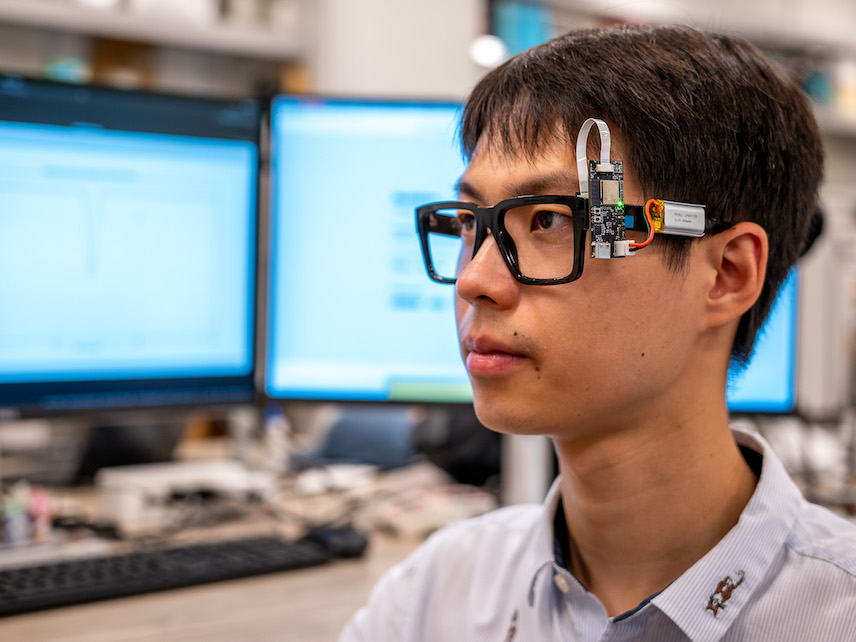
A glasses-mounted device tracks eye blinks down to the millisecond, revealing new insights into fatigue, stress, eye disease, and mental health.
People monitor health indicators such as steps, heart rate, calories and sleep, but they’re missing out on the information that can be gained by tracking a commonly overlooked bodily function: eye blinks.
Blink patterns provide an inside scoop into a person’s health. Fast blinks could be a sign of a heavy workload, while slow blinks are often a sign of drowsiness. Partial blinks could be the driving force behind chronic dry eye. Changing blink patterns over time could indicate progression in mental health disorders.
“Blinks are a good window into our brains,” said Dongyin Hu, a third-year doctoral student at the University of Pennsylvania who is part of a team that developed BlinkWise, a device that sits on to traditional glasses to tracks blinks down to the millisecond.
BlinkWise uses a radio-frequency (RF) sensor that’s approximately the size of a fingernail to detect eyelid movement. That movement is processed by an edge microcontroller unit (MCU) that’s the size of a USB flash drive. The sensor sits on the hinge of the glasses and the MCU sits on the temple arm, so neither affects vision.
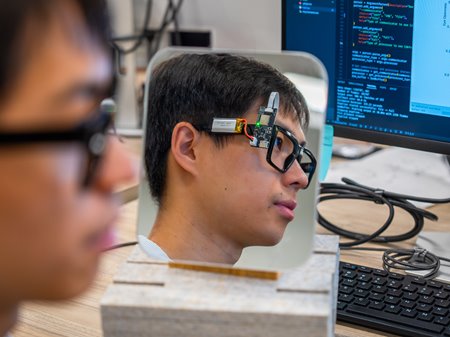 A researcher wears BlinkWise, a lightweight add-on mounted to the hinge and temple arm of standard glasses, as the system tracks eyelid movement with millisecond-level resolution while processing data locally on an embedded microcontroller. Image: Sylvia Zhang
“We designed BlinkWise to be a tiny add-on you can put on everyday glasses. It’s a smart device that can track the details of blinks to a very accurate resolution,” Hu said. “We’re not just interested in whether the eye is open or closed, but the exact openness: fully open, closed and the whole spectrum in between.”
A researcher wears BlinkWise, a lightweight add-on mounted to the hinge and temple arm of standard glasses, as the system tracks eyelid movement with millisecond-level resolution while processing data locally on an embedded microcontroller. Image: Sylvia Zhang
“We designed BlinkWise to be a tiny add-on you can put on everyday glasses. It’s a smart device that can track the details of blinks to a very accurate resolution,” Hu said. “We’re not just interested in whether the eye is open or closed, but the exact openness: fully open, closed and the whole spectrum in between.”
The technology measures blinks based on the openness of the eye, with a value between 0 and 1 (0 is fully closed and 1 is fully open). Eyelid movement is tracked at a time resolution of approximately 1 millisecond to capture subtle changes.
During pilot studies, the team found higher states of drowsiness recorded a 10-millisecond to 20-millisecond increase in how long the eye is closed and then reopens. Alternatively, fewer and faster blinks were recorded in wearers stressed with a higher workload.
Team members wore glasses while blinking and doing movements such as rolling their eyes, which revealed patterns that varied more than anticipated.
The team—which consists of Hu and fellow students Ahhyun Yuh and Zihao Wang, as well as postdoctoral researcher Xin Yang, assistant professor Mingmin Zhao, and professors Lama A. Al-Aswad and Insup Lee—found that BlinkWise required a lot of energy to process all the blink variations.
You May Want to Read: New Invention Could Revolutionize Wound Care
“We thought that we might be able to do simple signal processing, but eye movement is quite diverse across people,” Hu said.
To achieve the power necessary while maintaining its small size, they conducted a smart optimization of the data and then created the MCU. Enabling the system to run on an MCU was a challenge that took engineering to overcome because MCUs don’t typically have a lot of memory.
“The core challenge was making our machine learning algorithms work within the MCU's limited memory and computational constraints,” Hu said.
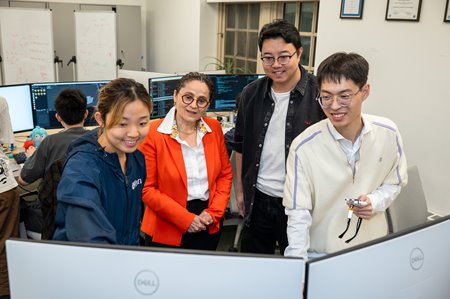 Members of the University of Pennsylvania research team demonstrate BlinkWise, a glasses-mounted system that tracks eye blinks with millisecond precision, as the device’s sensor and processing hardware are reviewed in a lab setting. Image: Sylvia Zhang
The team needed to enable high-resolution, continuous blink tracking on a system small enough to wear on glasses without the weight or size being a burden. They achieved the goal of a powerful but mobile solution by leveraging efficient sensing and computing.
Members of the University of Pennsylvania research team demonstrate BlinkWise, a glasses-mounted system that tracks eye blinks with millisecond precision, as the device’s sensor and processing hardware are reviewed in a lab setting. Image: Sylvia Zhang
The team needed to enable high-resolution, continuous blink tracking on a system small enough to wear on glasses without the weight or size being a burden. They achieved the goal of a powerful but mobile solution by leveraging efficient sensing and computing.
According to the team’s paper, “Tracking Blink Dynamics and Mental States on Glasses,” a lightweight U-Net-like convolutional neural network (CNN) captures continuous eye openness scores. Those scores can be used to derive the durations of different blink phases (closing, interphase, and reopening) and distinguish between partial and full blinks. Recurrentization reformulates CNNs into equivalent recurrent neural network structures to reduce the memory requirements.
The team created a lightweight event proposal algorithm to allow only potential blink events to be processed by the CNN network. They also developed a quantization-aware normalization pipeline that optimizes how the system represents data after quantization.
“Our optimizations, in both data and computation, make it possible to run the entire system on an MCU, which would otherwise be too resource-constrained to support BlinkWise,” Hu said.
Discover the Benefits of ASME Membership
This combination of technology allows BlinkWise to reduce memory by 10.67 times and achieve a 76.3 percent reduction in latency, resulting in powerful processing in the small, lightweight package that can run for a full day on one charge. And all data is processed locally, preventing privacy breaches.
The project began in 2023, as the engineering school team worked closely with medical students and ophthalmologists from Penn Medicine to determine areas of ophthalmology that could benefit from innovation.
Studies have shown that blinks are meaningful indicators of mental and eye health. But blink trackers have been constrained to lab environments, which are capable of high precision and continuous measurements. When technology is confined to a lab, it lacks the ability to track movements in real-world settings.
“BlinkWise is important because we want to fill in the gaps of lab conclusions,” Hu said. “BlinkWise can make an impact if it applies to everyday applications.”
Hu believes BlinkWise could be an important tool in monitoring health, pointing to potential applications in evaluating fatigue and stress due to a heavy workload. The tech can help evaluate a person’s physical health by identifying dry eye disease and even a person’s mental health, as studies show blink variations in people with neurodivergent conditions like Attention-Deficit/Hyperactivity Disorder, Autism Spectrum Disorder, and Alzheimer's Disease. By tracking blink patterns over time in real-world settings, medical professionals should be able to better track the progression of such health conditions.
Jessica Porter is an independent writer in Catskill, N.Y.
Blink patterns provide an inside scoop into a person’s health. Fast blinks could be a sign of a heavy workload, while slow blinks are often a sign of drowsiness. Partial blinks could be the driving force behind chronic dry eye. Changing blink patterns over time could indicate progression in mental health disorders.
“Blinks are a good window into our brains,” said Dongyin Hu, a third-year doctoral student at the University of Pennsylvania who is part of a team that developed BlinkWise, a device that sits on to traditional glasses to tracks blinks down to the millisecond.
A small package
BlinkWise uses a radio-frequency (RF) sensor that’s approximately the size of a fingernail to detect eyelid movement. That movement is processed by an edge microcontroller unit (MCU) that’s the size of a USB flash drive. The sensor sits on the hinge of the glasses and the MCU sits on the temple arm, so neither affects vision.
A researcher wears BlinkWise, a lightweight add-on mounted to the hinge and temple arm of standard glasses, as the system tracks eyelid movement with millisecond-level resolution while processing data locally on an embedded microcontroller. Image: Sylvia Zhang
The technology measures blinks based on the openness of the eye, with a value between 0 and 1 (0 is fully closed and 1 is fully open). Eyelid movement is tracked at a time resolution of approximately 1 millisecond to capture subtle changes.
During pilot studies, the team found higher states of drowsiness recorded a 10-millisecond to 20-millisecond increase in how long the eye is closed and then reopens. Alternatively, fewer and faster blinks were recorded in wearers stressed with a higher workload.
Behind the tech
Team members wore glasses while blinking and doing movements such as rolling their eyes, which revealed patterns that varied more than anticipated.
The team—which consists of Hu and fellow students Ahhyun Yuh and Zihao Wang, as well as postdoctoral researcher Xin Yang, assistant professor Mingmin Zhao, and professors Lama A. Al-Aswad and Insup Lee—found that BlinkWise required a lot of energy to process all the blink variations.
You May Want to Read: New Invention Could Revolutionize Wound Care
“We thought that we might be able to do simple signal processing, but eye movement is quite diverse across people,” Hu said.
To achieve the power necessary while maintaining its small size, they conducted a smart optimization of the data and then created the MCU. Enabling the system to run on an MCU was a challenge that took engineering to overcome because MCUs don’t typically have a lot of memory.
“The core challenge was making our machine learning algorithms work within the MCU's limited memory and computational constraints,” Hu said.
Members of the University of Pennsylvania research team demonstrate BlinkWise, a glasses-mounted system that tracks eye blinks with millisecond precision, as the device’s sensor and processing hardware are reviewed in a lab setting. Image: Sylvia Zhang
According to the team’s paper, “Tracking Blink Dynamics and Mental States on Glasses,” a lightweight U-Net-like convolutional neural network (CNN) captures continuous eye openness scores. Those scores can be used to derive the durations of different blink phases (closing, interphase, and reopening) and distinguish between partial and full blinks. Recurrentization reformulates CNNs into equivalent recurrent neural network structures to reduce the memory requirements.
The team created a lightweight event proposal algorithm to allow only potential blink events to be processed by the CNN network. They also developed a quantization-aware normalization pipeline that optimizes how the system represents data after quantization.
“Our optimizations, in both data and computation, make it possible to run the entire system on an MCU, which would otherwise be too resource-constrained to support BlinkWise,” Hu said.
Discover the Benefits of ASME Membership
This combination of technology allows BlinkWise to reduce memory by 10.67 times and achieve a 76.3 percent reduction in latency, resulting in powerful processing in the small, lightweight package that can run for a full day on one charge. And all data is processed locally, preventing privacy breaches.
Mobility to advance medical research
The project began in 2023, as the engineering school team worked closely with medical students and ophthalmologists from Penn Medicine to determine areas of ophthalmology that could benefit from innovation.
Studies have shown that blinks are meaningful indicators of mental and eye health. But blink trackers have been constrained to lab environments, which are capable of high precision and continuous measurements. When technology is confined to a lab, it lacks the ability to track movements in real-world settings.
“BlinkWise is important because we want to fill in the gaps of lab conclusions,” Hu said. “BlinkWise can make an impact if it applies to everyday applications.”
Hu believes BlinkWise could be an important tool in monitoring health, pointing to potential applications in evaluating fatigue and stress due to a heavy workload. The tech can help evaluate a person’s physical health by identifying dry eye disease and even a person’s mental health, as studies show blink variations in people with neurodivergent conditions like Attention-Deficit/Hyperactivity Disorder, Autism Spectrum Disorder, and Alzheimer's Disease. By tracking blink patterns over time in real-world settings, medical professionals should be able to better track the progression of such health conditions.
Jessica Porter is an independent writer in Catskill, N.Y.
A glasses-mounted device tracks eye blinks down to the millisecond, revealing new insights into fatigue, stress, eye disease, and mental health.

Freelance writer in New York
Related Content
.png?width=854&height=480&ext=.png)

Feb 20, 2026
Quiz: How Much Water Is AI Consuming?

Are AI prompts consuming water by the bottle, the gallon, or the lake? Take this quiz and see what you know about myths and facts around data centers and water use.

Feb 13, 2026
Quiz: Manufacturing Valentine’s Day

From candy making to digital twins, manufacturing shapes Valentine’s Day. See how much you know about how it’s made in this week’s ASME quiz.


Feb 9, 2026
Tiny Robots Now Can Explore and Treat the Body


A McMaster roboticist is developing tiny magnetic robots that have the ability to deliver drugs, take biopsies, and explore hard to reach areas inside the body.
Feb 2, 2026
Imaging Tool Reveals Oral Cancer Early

A smartphone-based device uses an imaging system and referral algorithm to help dental clinicians identify suspicious lesions.