Water Barrier Seeks to Protect Sailors from Jet Noise
Water Barrier Seeks to Protect Sailors from Jet Noise
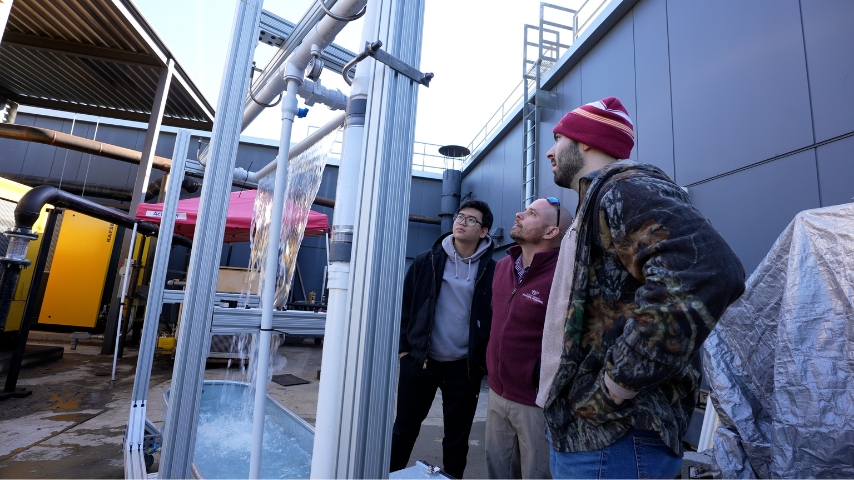
Engineering researchers at Virginia Tech and Brigham Young University are testing water barriers to reduce the dangerous noise levels naval personnel experience on aircraft carriers.
It takes a highly skilled pilot in the cockpit of a fighter jet to take off from and land on a Navy aircraft carrier—but it also requires support from a whole crew of sailors. It’s exciting to watch, but extremely dangerous for the crew. And one of the biggest dangers, believe it or not, is hearing loss.
A fighter jet produces noise levels of 150-180 decibels. This means navy personnel—even if they wear hearing protection correctly—are regularly exposed to sounds that are more than 200 percent above the 85-decibel threshold set by the U.S. Occupational Safety and Health Administration.
In fact, hearing damage is the most reported injury in the military, according to the U.S. Navy website. That’s why the Office of Naval Research (ONR) created the Jet Noise Reduction Program, which has given a $1.1 million grant to Virginia Tech and Brigham Young University (BYU) researchers to develop new hearing protection solutions.
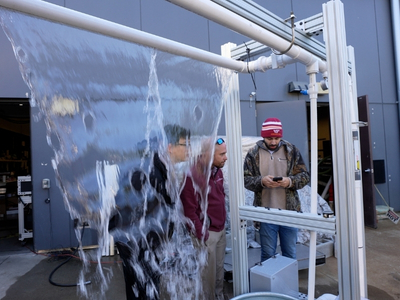 Ph.D. Student Aaron Hock makes an adjustment to the water flow in the bubble curtain device being built in the lab of Joseph Meadows, associate professor of mechanical engineering. Photo by Alex Parrish for Virginia Tech.
The solution the researchers are developing is a water barrier infused with bubbles—or a “bubble curtain”—an idea that came from techniques used in underwater marine construction, said Joseph Meadows, researcher and associate professor of mechanical engineering at Virginia Tech.
Ph.D. Student Aaron Hock makes an adjustment to the water flow in the bubble curtain device being built in the lab of Joseph Meadows, associate professor of mechanical engineering. Photo by Alex Parrish for Virginia Tech.
The solution the researchers are developing is a water barrier infused with bubbles—or a “bubble curtain”—an idea that came from techniques used in underwater marine construction, said Joseph Meadows, researcher and associate professor of mechanical engineering at Virginia Tech.
“Sound travels so fast underwater, and the noise can be harmful to marine life,” Meadows explained. “Researchers found that if you introduce bubbles, it can scatter and resonate acoustic waves and reduce the amount of sound that transmits.”
However, the technique works a little differently when you’re not underwater. “Now you have an acoustic wave traveling from air to water and then back to air,” Meadows said.
In the air, a barrier will cause reflection due to acoustic impedance. A curtain of flowing water without bubbles might be sufficient in this scenario. Meadows and BYU Professor Kent Gee are going to test the water barrier with and without bubbles to see which one is more effective.
This is not the first time experts have tried to reduce jet noise, but previous attempts have involved trying to make changes directly to the jet engine. Unfortunately, this has been detrimental to engine performance, so researchers concluded they needed some sort of barrier outside the plane.
 The water barrier is a unique solution, as it’s never been used in this way before, Meadows said. “Water deluge systems used in rocket launches have been shown to reduce acoustics, but the Navy has never attempted this before,” he explained.
The water barrier prototype the researchers developed is a simple device using PVC pipe and a pump that recirculates the water, creating a waterfall. They added air stones—commonly used in hydroponics—to infuse bubbles into the water.
“It’s basically a closed-loop recirculating water system with air injections. So, it’s a simple concept, which is the beauty of it,” Meadows said. “It’s not expensive, doesn’t have to be put on an engine, and doesn’t have any adverse effects to engine performance.”
The water barrier would be easier to create and implement without bubbles, but one of the challenges they are working to overcome is the effect of gravity. It’s difficult to maintain a wall of water as it’s falling because gravity tends to separate the water, allowing sound to get through. Researchers are working on optimizing the parameters by controlling the water pressure and angles.
“We can also add multiple layers of water,” Meadows said. “So, if one layer is separating periodically, then you have a second or third layer. The probability that all three are going to separate at the exact same location goes down. So, even if you have separation, a multi-layer barrier could help alleviate some of those challenges.”
The researchers will be testing the water barrier in early spring using the afterburning jet noise rig Meadows previously developed. The rig is the only lab-based machine of its kind.
“I have a unique facility that can produce supersonic jet noise at afterburning and military power conditions. To my knowledge, no other laboratory has successfully reproduced the acoustic field at these conditions,” Meadows said. This will be very helpful for testing different parameters and prototypes of their noise-reducing water barrier and demonstrating its effectiveness in a relevant acoustic environment.
But this is more than just a demonstration project, Meadows added.
“Professor Kent Gee [of BYU] has developed analytical tools to predict the transmission and diffraction around the barrier,” he said. “If successful, we will deliver a recommendation, a design philosophy with theoretical models to predict performance, and demonstrate something that’s never been done before.”
Claudia Hoffacker is an independent writer based in Minneapolis.
A fighter jet produces noise levels of 150-180 decibels. This means navy personnel—even if they wear hearing protection correctly—are regularly exposed to sounds that are more than 200 percent above the 85-decibel threshold set by the U.S. Occupational Safety and Health Administration.
Testing a water barrier to reduce noise
In fact, hearing damage is the most reported injury in the military, according to the U.S. Navy website. That’s why the Office of Naval Research (ONR) created the Jet Noise Reduction Program, which has given a $1.1 million grant to Virginia Tech and Brigham Young University (BYU) researchers to develop new hearing protection solutions.
Ph.D. Student Aaron Hock makes an adjustment to the water flow in the bubble curtain device being built in the lab of Joseph Meadows, associate professor of mechanical engineering. Photo by Alex Parrish for Virginia Tech.
“Sound travels so fast underwater, and the noise can be harmful to marine life,” Meadows explained. “Researchers found that if you introduce bubbles, it can scatter and resonate acoustic waves and reduce the amount of sound that transmits.”
However, the technique works a little differently when you’re not underwater. “Now you have an acoustic wave traveling from air to water and then back to air,” Meadows said.
In the air, a barrier will cause reflection due to acoustic impedance. A curtain of flowing water without bubbles might be sufficient in this scenario. Meadows and BYU Professor Kent Gee are going to test the water barrier with and without bubbles to see which one is more effective.
A simple answer to complex challenge
This is not the first time experts have tried to reduce jet noise, but previous attempts have involved trying to make changes directly to the jet engine. Unfortunately, this has been detrimental to engine performance, so researchers concluded they needed some sort of barrier outside the plane.
A Device to Tune In or Out
How humans speak, by taking turns, forms the basis for automated AI-driven proactive hearing assistance.
The water barrier prototype the researchers developed is a simple device using PVC pipe and a pump that recirculates the water, creating a waterfall. They added air stones—commonly used in hydroponics—to infuse bubbles into the water.
“It’s basically a closed-loop recirculating water system with air injections. So, it’s a simple concept, which is the beauty of it,” Meadows said. “It’s not expensive, doesn’t have to be put on an engine, and doesn’t have any adverse effects to engine performance.”
The water barrier would be easier to create and implement without bubbles, but one of the challenges they are working to overcome is the effect of gravity. It’s difficult to maintain a wall of water as it’s falling because gravity tends to separate the water, allowing sound to get through. Researchers are working on optimizing the parameters by controlling the water pressure and angles.
“We can also add multiple layers of water,” Meadows said. “So, if one layer is separating periodically, then you have a second or third layer. The probability that all three are going to separate at the exact same location goes down. So, even if you have separation, a multi-layer barrier could help alleviate some of those challenges.”
Testing noise reduction in a one-of-a-kind lab
The researchers will be testing the water barrier in early spring using the afterburning jet noise rig Meadows previously developed. The rig is the only lab-based machine of its kind.
“I have a unique facility that can produce supersonic jet noise at afterburning and military power conditions. To my knowledge, no other laboratory has successfully reproduced the acoustic field at these conditions,” Meadows said. This will be very helpful for testing different parameters and prototypes of their noise-reducing water barrier and demonstrating its effectiveness in a relevant acoustic environment.
But this is more than just a demonstration project, Meadows added.
“Professor Kent Gee [of BYU] has developed analytical tools to predict the transmission and diffraction around the barrier,” he said. “If successful, we will deliver a recommendation, a design philosophy with theoretical models to predict performance, and demonstrate something that’s never been done before.”
Claudia Hoffacker is an independent writer based in Minneapolis.
Engineering researchers at Virginia Tech and Brigham Young University are testing water barriers to reduce the dangerous noise levels naval personnel experience on aircraft carriers.

Independent writer and editor
Related Content

Jun 29, 2026
A Device to Tune In or Out

How humans speak, by taking turns, forms the basis for automated AI-driven proactive hearing assistance.

Jun 24, 2026
Sound on Mars?
Researchers are modeling how the red planet’s conditions affect sound. The answers might help future missions.

Mar 20, 2026
Quiz: Mechanisms Behind the Music

Up to facing the music? Test your instrument knowledge with this ASME quiz.

Nov 18, 2025
A Surface Slicker Than Ice