A Viral Solution to Sustainable Rare Earth Mining
A Viral Solution to Sustainable Rare Earth Mining
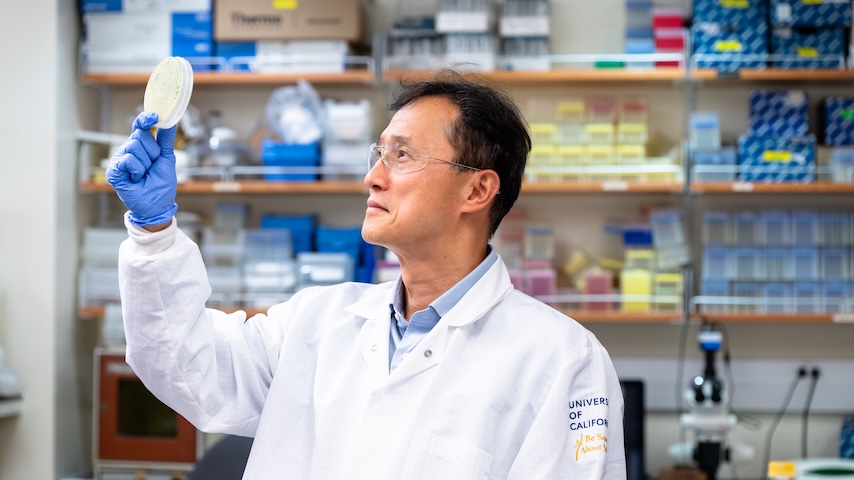
Genetically engineered viruses have unlocked a cleaner and more efficient way to extract rare earth minerals.
Rare earth elements (REE) are widely used in military, electronic, and green energy technologies. But traditional mining methods are difficult, expensive, and harmful to the environment.
Producers most often extract REEs through open pit mining. Once the ore is removed from the earth, it’s crushed and separated into REE-bearing minerals and waste rock. Waste rock often includes radioactive elements like thorium and uranium that get left behind in the mining process. REEs are extracted from the minerals using sulfuric acid, hydrochloric acid, or sodium hydroxide.
A team from the University of California, Berkeley’s (UC Berkeley) Department of Bioengineering is working on developing a more sustainable and effective way to extract REEs: A virus-based, thermoresponsive REE separation platform that works in aqueous environments using a genetically engineered filamentous bacteriophage. This work was recently published as “Virus-Based Thermoresponsive Separation of Rare-Earth Elements” in the American Chemical Society’s Nano Letters Journal.
“Viruses have a self-replicating power. It’s difficult to get rid of them because they evolve very quickly. So once a virus is made, it has very useful characteristics other materials don't have,” explained Seung-Wuk Lee, a professor in UC Berkeley’s Department of Bioengineering and a faculty scientist of Biological Systems and Engineering for the Lawrence Berkeley National Laboratory. “We can design viruses through evolution and use viruses to solve challenging engineering and scientific problems.”
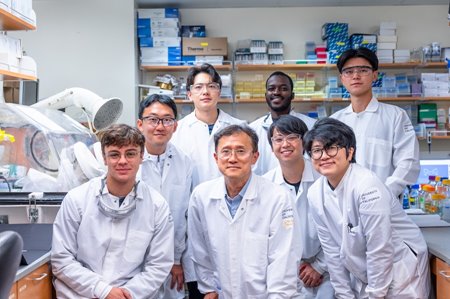 The team of UC Berkeley-led researchers who have genetically engineered a virus to act like a smart sponge, grabbing rare earth metals from water. Photo: Yungyu Lee
Researchers added two proteins to the bacteriophage, which work together to extract and release REEs. The first is a lanthanide-binding peptide (LBP) that engineers the virus to recognize and bind to REEs. Second is a thermoresponsive elastin-like peptide (ELP), which is solid at body temperature but soluble at room temperature.
The team of UC Berkeley-led researchers who have genetically engineered a virus to act like a smart sponge, grabbing rare earth metals from water. Photo: Yungyu Lee
Researchers added two proteins to the bacteriophage, which work together to extract and release REEs. The first is a lanthanide-binding peptide (LBP) that engineers the virus to recognize and bind to REEs. Second is a thermoresponsive elastin-like peptide (ELP), which is solid at body temperature but soluble at room temperature.
Adjusting the temperature induces the ELP to precipitate and changing pH levels makes the LBP release the REEs.
“The virus can recognize REEs and absorb all of them,” Lee said. “Then, they go to each other and precipitate out the REEs.” This combination results in selective lanthanide binding and temperature-induced coacervation of REEs in aqueous environments.
LBPs show a preference for heavy REEs compared to light REEs. LBPs cause internal fractionation of the elements, meaning the virus disrupts their natural proportions to become more enriched in heavy REEs. Though both are widely used in technology applications, heavy REEs are critical for many military technologies.
The team found the virus can repeat this process multiple times once the temperature cools, with some viruses successfully completing the process five to 10 times. The repeatability represents a scalable and sustainable strategy for recovering REEs, according to the paper.
Discover the Benefits of ASME Membership
“Viruses are very robust materials,” Lee said. “They survive, and they still infect bacteria, so we can use them to produce more viruses.”
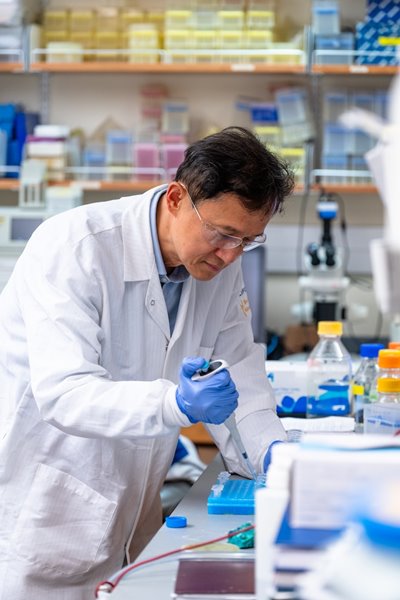 The researchers envision this platform eventually being used for other critical applications, including harvesting REEs from e-waste, such as old phones or laptops, and for environmental remediation. Photo: Yungyu Lee
In the 1960s and 1970s, the United States was one of the largest producers of REEs, due in large part to the Mountain Pass mine in California. Once the amount of contamination was discovered, as well as mounting regulatory pressure and pressure in the global market, American production halted and China became the top producer. The effort aims to reduce reliance on international production.
The researchers envision this platform eventually being used for other critical applications, including harvesting REEs from e-waste, such as old phones or laptops, and for environmental remediation. Photo: Yungyu Lee
In the 1960s and 1970s, the United States was one of the largest producers of REEs, due in large part to the Mountain Pass mine in California. Once the amount of contamination was discovered, as well as mounting regulatory pressure and pressure in the global market, American production halted and China became the top producer. The effort aims to reduce reliance on international production.
You Might Also Enjoy: Mining Seaweed for Minerals
The team began research right away after the funding was received in 2022, by working to categorize and construct the viruses. By 2024, they demonstrated they could separate REEs with LBP-engineered viruses. Last year, the team encoded LBP and ELP on viruses and produced the sponge-like virus.
“It is scientifically feasible we can use viruses for the separation. To use it on an industrial scale, we need a jump in terms of a huge investment,” Lee said. “This technology still is quite expensive, so we need to figure out how to achieve this process in a more economically viable way.”
The UC Berkeley research team’s efforts show promise in more sustainable REE extraction for today’s much-needed technologies.
“We hope this process can tackle the challenging problem of biomining of critical elements,” Lee said.
Jessica Porter is an independent writer in New York.
Producers most often extract REEs through open pit mining. Once the ore is removed from the earth, it’s crushed and separated into REE-bearing minerals and waste rock. Waste rock often includes radioactive elements like thorium and uranium that get left behind in the mining process. REEs are extracted from the minerals using sulfuric acid, hydrochloric acid, or sodium hydroxide.
A team from the University of California, Berkeley’s (UC Berkeley) Department of Bioengineering is working on developing a more sustainable and effective way to extract REEs: A virus-based, thermoresponsive REE separation platform that works in aqueous environments using a genetically engineered filamentous bacteriophage. This work was recently published as “Virus-Based Thermoresponsive Separation of Rare-Earth Elements” in the American Chemical Society’s Nano Letters Journal.
A sustainable solution
Bacteriophages have long been studied in scientific communities and are harmless, only infecting bacteria.“Viruses have a self-replicating power. It’s difficult to get rid of them because they evolve very quickly. So once a virus is made, it has very useful characteristics other materials don't have,” explained Seung-Wuk Lee, a professor in UC Berkeley’s Department of Bioengineering and a faculty scientist of Biological Systems and Engineering for the Lawrence Berkeley National Laboratory. “We can design viruses through evolution and use viruses to solve challenging engineering and scientific problems.”
The team of UC Berkeley-led researchers who have genetically engineered a virus to act like a smart sponge, grabbing rare earth metals from water. Photo: Yungyu Lee
Adjusting the temperature induces the ELP to precipitate and changing pH levels makes the LBP release the REEs.
“The virus can recognize REEs and absorb all of them,” Lee said. “Then, they go to each other and precipitate out the REEs.” This combination results in selective lanthanide binding and temperature-induced coacervation of REEs in aqueous environments.
LBPs show a preference for heavy REEs compared to light REEs. LBPs cause internal fractionation of the elements, meaning the virus disrupts their natural proportions to become more enriched in heavy REEs. Though both are widely used in technology applications, heavy REEs are critical for many military technologies.
Put to the test
Researchers tested the viruses using drainage from an REE mine. The viruses attached themselves to REE ions in the drainage. Researchers warmed the solution, causing the viruses to clump together and sink to the bottom of a tank. They drained the liquid, leaving the viruses and solid REEs. Then, the team adjusted the acidity, which caused the viruses to release the elements.The team found the virus can repeat this process multiple times once the temperature cools, with some viruses successfully completing the process five to 10 times. The repeatability represents a scalable and sustainable strategy for recovering REEs, according to the paper.
Discover the Benefits of ASME Membership
“Viruses are very robust materials,” Lee said. “They survive, and they still infect bacteria, so we can use them to produce more viruses.”
Incentive to innovate
In 2022, UC Berkeley received $2 million in funding to research alternatives to REE extraction through the U.S. National Science Foundation’s Emerging Frontiers in Research and Innovation (EFRI) program. EFRI is a result of an executive order issued by former President Joe Biden in 2020 to encourage research into cleaner extraction methods that would allow the United States to extract REEs independently by 2026.
The researchers envision this platform eventually being used for other critical applications, including harvesting REEs from e-waste, such as old phones or laptops, and for environmental remediation. Photo: Yungyu Lee
You Might Also Enjoy: Mining Seaweed for Minerals
The team began research right away after the funding was received in 2022, by working to categorize and construct the viruses. By 2024, they demonstrated they could separate REEs with LBP-engineered viruses. Last year, the team encoded LBP and ELP on viruses and produced the sponge-like virus.
“It is scientifically feasible we can use viruses for the separation. To use it on an industrial scale, we need a jump in terms of a huge investment,” Lee said. “This technology still is quite expensive, so we need to figure out how to achieve this process in a more economically viable way.”
The UC Berkeley research team’s efforts show promise in more sustainable REE extraction for today’s much-needed technologies.
“We hope this process can tackle the challenging problem of biomining of critical elements,” Lee said.
Jessica Porter is an independent writer in New York.
Genetically engineered viruses have unlocked a cleaner and more efficient way to extract rare earth minerals.

Freelance writer in New York
Related Content

Jun 9, 2026
The Next Era of Programmable Matter

Researchers have unlocked robotic building blocks using electrically heated elements that turn solids to liquids, which allows the material to mimic a wide range of mechanical behaviors.
May 26, 2026
Researchers Develop ‘Super Foam’ That Could Reduce Injuries and Save Lives

Using a process called IFAM, Texas A&M researchers created a hybrid composite that is tunable, lightweight, and ultra-durable.
May 12, 2026
The End of Brittle Solar


Flexible carbon nanotubes replace brittle ITO in perovskite solar cells, boosting durability, efficiency, and lowering costs for next generation renewables.
Apr 30, 2026
Engineers Scale Up Smart Ceramic Composites


Researchers scaled smart ceramics by embedding shape memory particles in ductile metal, creating a tough composite that keeps the transformation effect.