Paying Mechanical Engineers in Professional Services
Paying Mechanical Engineers in Professional Services

Mechanical engineers who work in professional services face complex projects, demanding clients, and multidisciplined deliverables. Add retiring staff and wages are up and are expected to keep rising.
To meet ever-rising industry demands, mechanical engineers pursue training and education to expand their technical toolkit, they hone their presentation abilities, and work on other soft skills. And amid these endeavors, MEs are in low number and in high demand.
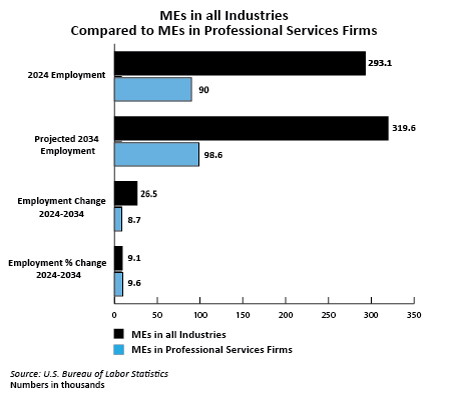
There are slightly more than 293,000 MEs working in the United States. Twenty percent of these professionals work in architectural and engineering (AE) services.
MEs working in engineering firms across the nation face many challenges including complex projects, tough client demands, and multidisciplined deliverables. The result of these developments, in the AE sector, ME wages are up and are expected to keep rising over the next decade.
 Using salary data (“2025 Mid-Year Compensation Update”) collected between January and June of 2025 compared to numbers collected in 2024, Zweig Group’s Manager of Awards and Analytics Kyle Ahern explained that salaries for MEs have increased.
“Overall for MEs, salaries have increased slightly,” he explained. Year over year, when looking at salaries across the board, they are up only slightly by 1.1 percent. Those MEs who hold associate and departmental managers position saw the largest salary increase—even larger than those who own the firms. But this was only a modest increase and entry level staffers actually lost ground, slightly.
Ahern offers the following salary breakdown for MEs working in firms:
And while no firm on the 2025 Zweig’s 2025 Hot Firms List (the 100 fastest-growing AEC firms in the United States and Canada) provide ME services exclusively, 44 percent provide such services “in some capacity.” These firms “saw an average three-year growth of 'Gross Service Revenue' of 112 percent,” Ahern said.
Zweig has a compensation data platform—a benchmarking tool—that interactively allows firms to compare their data to industry benchmarking numbers. Zweig Insights is designed to help architecture, engineering, and construction firms make better decisions, Ahern said.
 Growth and profitability are at a record high, explained Ahern. But he added that the AEC industry’s backlog is also at an all-time high. “It does not seem like the work will be slowing down anytime soon,” he said. So the outlook for the industry is very strong and MEs within the industry have a strong outlook as well, Ahern added.
Cathy Cecere is membership content program manager.
There are slightly more than 293,000 MEs working in the United States. Twenty percent of these professionals work in architectural and engineering (AE) services.
MEs working in engineering firms across the nation face many challenges including complex projects, tough client demands, and multidisciplined deliverables. The result of these developments, in the AE sector, ME wages are up and are expected to keep rising over the next decade.
Salaries are up but not for everyone
“Overall for MEs, salaries have increased slightly,” he explained. Year over year, when looking at salaries across the board, they are up only slightly by 1.1 percent. Those MEs who hold associate and departmental managers position saw the largest salary increase—even larger than those who own the firms. But this was only a modest increase and entry level staffers actually lost ground, slightly.
Ahern offers the following salary breakdown for MEs working in firms:
- Entry level has seen a very small decrease of -0.01 percent.
- Project engineers' salaries have increased slightly by .29 percent.
- Project managers saw an increase of 2.02 percent.
- Associate/department managers saw the largest increase of 4.02 percent.
- Principals also saw an increase—3.03 percent.
And while no firm on the 2025 Zweig’s 2025 Hot Firms List (the 100 fastest-growing AEC firms in the United States and Canada) provide ME services exclusively, 44 percent provide such services “in some capacity.” These firms “saw an average three-year growth of 'Gross Service Revenue' of 112 percent,” Ahern said.
Future looks good
Zweig has a compensation data platform—a benchmarking tool—that interactively allows firms to compare their data to industry benchmarking numbers. Zweig Insights is designed to help architecture, engineering, and construction firms make better decisions, Ahern said.
Quiz: U.S. Manufacturing Salaries in 2025
Find out what you know when it comes to the mechanical engineers who work in the manufacturing sector with this ASME quiz.
Cathy Cecere is membership content program manager.


Learning is a lifelong journey. Explore our growing collection of free learning resources and articles.