Redefining Lithium Dendrites for Better Batteries
Redefining Lithium Dendrites for Better Batteries
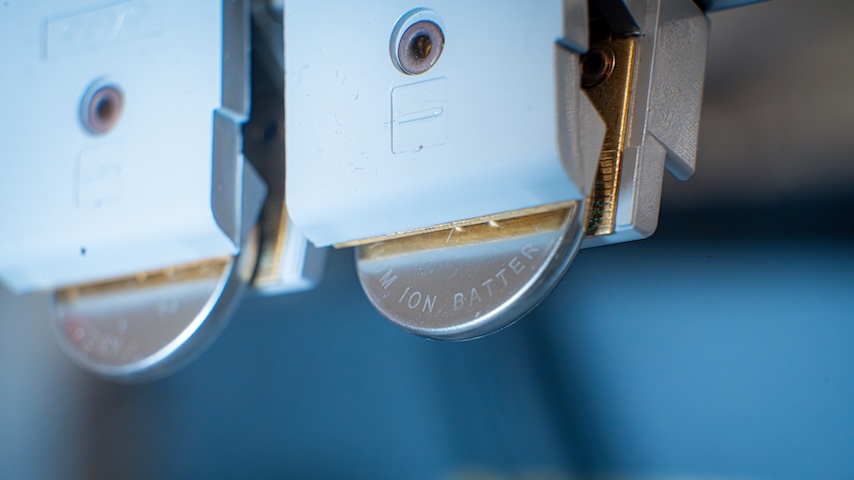
Understanding how lithium dendrites behave inside batteries may be the key to unlocking improved energy storage.
A fundamental material challenge has stalled high-capacity energy storage for decades. Although lithium traditionally acts as a soft, compliant metal, its dendritic formations behave as high-strength mechanical wedges, triggering safety incidents and battery shorts since the 1970s. However, by developing a complex, air-free method to harvest and test individual filaments, researchers have discovered that lithium dendrites can grow as unexpectedly strong, brittle needles rather than soft whiskers.
These microscopic filaments exhibit fracture stresses 150 times greater than bulk lithium, effectively acting as rigid projectiles that pierce even the most advanced solid electrolytes. While engineers previously assumed that hard solid electrolytes would mechanically block these formations, the high yield strength and brittle characteristics discovered in “Strong and brittle lithium dendrites,” published in Science earlier this year, explained the continued issues with internal short circuits.
“Lithium is a soft material. Engineers have tried to suppress dendrite formation with hard or stiff electrolyte materials. Despite this effort, dendrites still form and batteries still fail,” explained Jun Lou, professor in the Department of Materials Science and Nanoengineering and the Rice Advanced Materials Institute at Rice University.
This research was a collaboration with Rice University, Georgia Institute of Technology, University of Houston, and the Nanyang Technological University in Singapore, with support from the U.S. Department of Energy, The Welch Foundation, and the U.S. National Science Foundation.
Dendritic lithium originates at the anode-electrolyte interface during battery charging when ions deposit unevenly onto the negative electrode rather than plating in smooth, uniform layers. These whiskers bypass liquid electrolyte separators to reach the cathode, triggering internal short circuits and thermal runaway.
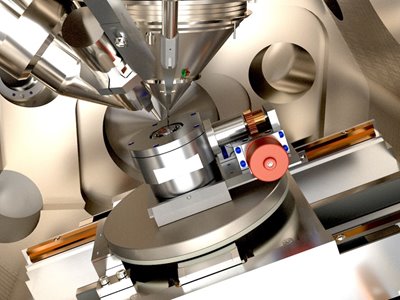 Views of the air-free sample transfer box inside the scanning electron microscope chamber with the lithium dendrite sample successfully transferred. Photo: Lou Group/Rice University
But these filaments are composite structures, not pure metal.
Views of the air-free sample transfer box inside the scanning electron microscope chamber with the lithium dendrite sample successfully transferred. Photo: Lou Group/Rice University
But these filaments are composite structures, not pure metal.
“People normally think about lithium dendrites as pure lithium, but we discovered that they’re a composite with a lithium core, covered with the solid electrolyte interface layer,” Lou explained.
That shell transforms the lithium into a high-strength, brittle needle.
Unlike bulk lithium, which yields and reshapes itself under pressure, these nanoscale filaments exhibit no plastic deformation. They maintained their sharp, rigid profiles even as the battery shifted from charging to discharging. When the rest of the anode contracted, these non-deformable structures remained as permanent obstructions.
You Might Also Enjoy: Shaping the Demand and Supply Mechanics of Lithium
Mechanical stress during cycling caused these brittle needles to fracture, severing their electrical connection to the main electrode. This process forms dead lithium, an electrochemically inactive material that permanently reduces battery capacity. The metallic fragments remain trapped within the cell, effectively stripping the battery of usable energy and creating internal debris that stifles long-term performance.
The extreme sensitivity of lithium dendrites to air and moisture required specialized air-free transfer and testing equipment. So, the Rice team grew dendrites ranging from a few tens to a few hundreds of nanometers in diameter and transported them via a custom airtight box to a focused ion beam scanning electron microscope (FIB-SEM). This isolated environment prevented the immediate chemical degradation that occurs upon contact with oxygen or moisture, thereby preserving the lithium’s authentic mechanical properties.
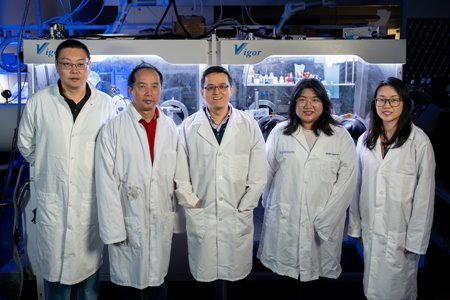 Rice University researchers from left: Hua Guo, Wenhua Guo, Jun Lou, Xintong Weng, and Yimo Han
Photo: Jorge Vidal/Rice University
“Dendrites are microscopic and incredibly difficult to handle. Because air or moisture immediately compromises the sample, we spent years developing a sophisticated, airtight transfer system and mechanical testing platform just to move them between instruments for characterization,” Lou explained.
Rice University researchers from left: Hua Guo, Wenhua Guo, Jun Lou, Xintong Weng, and Yimo Han
Photo: Jorge Vidal/Rice University
“Dendrites are microscopic and incredibly difficult to handle. Because air or moisture immediately compromises the sample, we spent years developing a sophisticated, airtight transfer system and mechanical testing platform just to move them between instruments for characterization,” Lou explained.
The harvesting process required precision nanomanipulation to maintain structural integrity during the transition from the growth substrate to the testing platform. Once secured inside the microscope, a probe mounted the individual filaments onto a microelectromechanical system (MEMS) device. This specialized tool converted compressive force into a uniaxial tensile force, enabling the first quantitative measurement of these brittle, high-strength crystals.
Researchers proposed several strategies to suppress dendrite formation by addressing the mechanical and electrochemical root causes of growth. One primary approach involved lithium alloy anodes, such as Li-Mg (lithium-magnesium) or Li-Zn (lithium-zinc), to modify the intrinsic plasticity of the lithium source. These alloys provided abundant dislocation nucleation sites within the metal core, which facilitated plastic deformation and prevented the development of high-stress, brittle needles.
Discover the Benefits of ASME Membership
The team also explored advanced materials to engineer the boundary layer that formed at the lithium-electrolyte interface. Since this interfacial shell often acted as a stiff constraint, researchers sought engineered layers with tailored mechanical properties. These modified interfaces could promote more uniform lithium deposition, discouraging the formation of rigid, wedge-like dendrites.
The shift from viewing lithium as a soft metal to a brittle, high-strength crystal provides a clearer explanation of why even the stiffest electrolytes fail during cycling. This new framework for battery design offers a development strategy to transition from reactive containment to proactive prevention through alloyed anodes and tailored interfaces.
Nicole Imeson is an engineer and writer in Calgary, Alberta.
These microscopic filaments exhibit fracture stresses 150 times greater than bulk lithium, effectively acting as rigid projectiles that pierce even the most advanced solid electrolytes. While engineers previously assumed that hard solid electrolytes would mechanically block these formations, the high yield strength and brittle characteristics discovered in “Strong and brittle lithium dendrites,” published in Science earlier this year, explained the continued issues with internal short circuits.
“Lithium is a soft material. Engineers have tried to suppress dendrite formation with hard or stiff electrolyte materials. Despite this effort, dendrites still form and batteries still fail,” explained Jun Lou, professor in the Department of Materials Science and Nanoengineering and the Rice Advanced Materials Institute at Rice University.
This research was a collaboration with Rice University, Georgia Institute of Technology, University of Houston, and the Nanyang Technological University in Singapore, with support from the U.S. Department of Energy, The Welch Foundation, and the U.S. National Science Foundation.
In the whiskers
Dendritic lithium originates at the anode-electrolyte interface during battery charging when ions deposit unevenly onto the negative electrode rather than plating in smooth, uniform layers. These whiskers bypass liquid electrolyte separators to reach the cathode, triggering internal short circuits and thermal runaway.
Views of the air-free sample transfer box inside the scanning electron microscope chamber with the lithium dendrite sample successfully transferred. Photo: Lou Group/Rice University
“People normally think about lithium dendrites as pure lithium, but we discovered that they’re a composite with a lithium core, covered with the solid electrolyte interface layer,” Lou explained.
That shell transforms the lithium into a high-strength, brittle needle.
Unlike bulk lithium, which yields and reshapes itself under pressure, these nanoscale filaments exhibit no plastic deformation. They maintained their sharp, rigid profiles even as the battery shifted from charging to discharging. When the rest of the anode contracted, these non-deformable structures remained as permanent obstructions.
You Might Also Enjoy: Shaping the Demand and Supply Mechanics of Lithium
Mechanical stress during cycling caused these brittle needles to fracture, severing their electrical connection to the main electrode. This process forms dead lithium, an electrochemically inactive material that permanently reduces battery capacity. The metallic fragments remain trapped within the cell, effectively stripping the battery of usable energy and creating internal debris that stifles long-term performance.
Harvesting and testing
The extreme sensitivity of lithium dendrites to air and moisture required specialized air-free transfer and testing equipment. So, the Rice team grew dendrites ranging from a few tens to a few hundreds of nanometers in diameter and transported them via a custom airtight box to a focused ion beam scanning electron microscope (FIB-SEM). This isolated environment prevented the immediate chemical degradation that occurs upon contact with oxygen or moisture, thereby preserving the lithium’s authentic mechanical properties.
Rice University researchers from left: Hua Guo, Wenhua Guo, Jun Lou, Xintong Weng, and Yimo Han
Photo: Jorge Vidal/Rice University
The harvesting process required precision nanomanipulation to maintain structural integrity during the transition from the growth substrate to the testing platform. Once secured inside the microscope, a probe mounted the individual filaments onto a microelectromechanical system (MEMS) device. This specialized tool converted compressive force into a uniaxial tensile force, enabling the first quantitative measurement of these brittle, high-strength crystals.
Potential paths forward
Researchers proposed several strategies to suppress dendrite formation by addressing the mechanical and electrochemical root causes of growth. One primary approach involved lithium alloy anodes, such as Li-Mg (lithium-magnesium) or Li-Zn (lithium-zinc), to modify the intrinsic plasticity of the lithium source. These alloys provided abundant dislocation nucleation sites within the metal core, which facilitated plastic deformation and prevented the development of high-stress, brittle needles.
Discover the Benefits of ASME Membership
The team also explored advanced materials to engineer the boundary layer that formed at the lithium-electrolyte interface. Since this interfacial shell often acted as a stiff constraint, researchers sought engineered layers with tailored mechanical properties. These modified interfaces could promote more uniform lithium deposition, discouraging the formation of rigid, wedge-like dendrites.
The shift from viewing lithium as a soft metal to a brittle, high-strength crystal provides a clearer explanation of why even the stiffest electrolytes fail during cycling. This new framework for battery design offers a development strategy to transition from reactive containment to proactive prevention through alloyed anodes and tailored interfaces.
Nicole Imeson is an engineer and writer in Calgary, Alberta.


As renewable energy gains momentum, oil and natural gas continue to remain primary global energy sources. This collection delves into latest digital trends enabling breakthroughs in energy transformation.