Ultra-Fine 3D Printing with a Mosquito’s Mouth
Ultra-Fine 3D Printing with a Mosquito’s Mouth
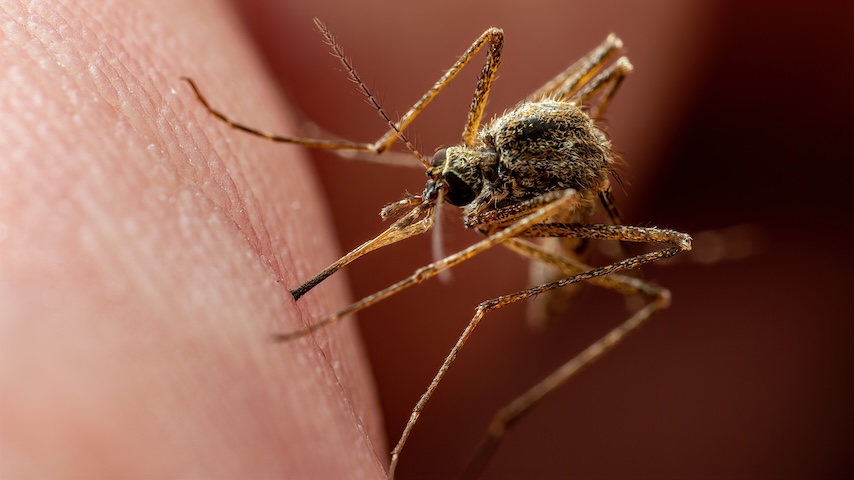
A nature-inspired solution merges the feeding tube of a mosquito with a 3D printer that can achieve a surprising resolution.
Sometimes the answers scientists seek aren’t in a new invention, but in one of the oldest—and in this case, in nature. Changhong Cao, assistant professor and Canada Research Chair in Small-Scale Materials and Manufacturing at McGill University was working on two projects in 2022: one in which he needed a tiny nozzle to use in small-scale printing and another project developing a topical cream to prevent mosquito bites. He talked to his team when the two projects “merged” in his head. “Could we try using those little [mosquito] mouthpieces as a 3D nozzle? The student thought I was crazy,” Cao recalled.
But he wasn’t. In November, his team published research in Science Advances on leveraging such “biotic material” for 3D necroprinting. Nature already had a solution: environmentally friendly feeding tubes, harvested from dead mosquitoes in the lab. But that idea is just where the work began.
“My first thought was to ask coauthor Justin Puma to the lake and use a net to capture some,” Cao said. “In the beginning, we didn’t think of a lab—we just wanted to give it a try.” Later, he talked to his colleague on the mosquito cream project to see if they could try with around 20 mosquitoes, but his colleague said, “I have to ship you at least 10,000.” That’s because the creatures are a biohazard, sanitized and stored in the freezer according to a certain process.
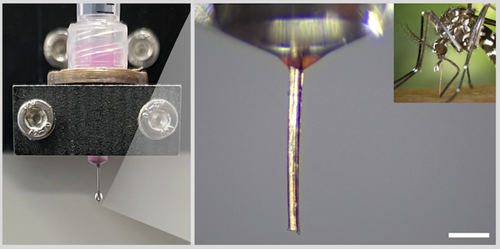 Experimental setup showing the female mosquito proboscis mounted on a custom 3D DIW printer. The proboscis is attached to a standard 30G dispense tip using resin support. Photo: Puma, et al.
So, Cao took them all—and there are still around 9,000 left. The mosquitoes were ethically sourced from Drexel University, which also collaborated on the project.
Experimental setup showing the female mosquito proboscis mounted on a custom 3D DIW printer. The proboscis is attached to a standard 30G dispense tip using resin support. Photo: Puma, et al.
So, Cao took them all—and there are still around 9,000 left. The mosquitoes were ethically sourced from Drexel University, which also collaborated on the project.
Isolating the tube was the next challenge. Cao bought a wash repair kit with a magnifier and other supplies to see the tiny tubes.
The “blood-sucking straw” that Cao’s team was interested in is one of the six tubes that mosquitoes have in their mouth pieces, or proboscis. “We thought if they could use it to flow food inside of that little channel, that’s great, but at the tip is a wedge—we had to cut that to make it flow better as a printer,” he said.
The conductive polymers they were trying to print were too thick, so they switched to bio ink that’s used for bio printing as the benchmark in the project. They were also able to print red blood cells as proof of concept, Cao said.
To make the tube stronger, they are working on coating the tube with ceramic material to withstand more pressure and stress. “That will really open up the library of materials we can work with, such as regular inks,” he continued.
More for You: 3D-Printed Dental Crowns Ready in Hours
The resulting print is 20 micrometers, which is “pretty impressive,” Cao noted, adding that it’s not possible to buy a nozzle on the market that will provide that resolution. The closest is around 50 micrometers. In addition, the product can withstand pressures of 60 kPa.
End users would likely be those who are working in bio printing or single-cell printing. Of course, using organic parts means that they break down, so there is a set time span during which the nozzles are useful. Most lasted for around 14 days, but in some cases up to one month. And to ensure their lifespan, creating the nozzles requires newly dead mosquitos.
But this project is just the start. Now, Cao’s team is giving second thought to what other processes and inventions could work this way. “It’s interesting how mosquitoes and ticks and hornets, with stingers and things,” could help in the future, Cao added.
Alexandra Frost is an independent writer and content strategist in Cincinnati.
But he wasn’t. In November, his team published research in Science Advances on leveraging such “biotic material” for 3D necroprinting. Nature already had a solution: environmentally friendly feeding tubes, harvested from dead mosquitoes in the lab. But that idea is just where the work began.
Harvesting and modification
The next question was where to find a whole bunch of dead mosquitoes to harvest their tubes.“My first thought was to ask coauthor Justin Puma to the lake and use a net to capture some,” Cao said. “In the beginning, we didn’t think of a lab—we just wanted to give it a try.” Later, he talked to his colleague on the mosquito cream project to see if they could try with around 20 mosquitoes, but his colleague said, “I have to ship you at least 10,000.” That’s because the creatures are a biohazard, sanitized and stored in the freezer according to a certain process.
Experimental setup showing the female mosquito proboscis mounted on a custom 3D DIW printer. The proboscis is attached to a standard 30G dispense tip using resin support. Photo: Puma, et al.
Isolating the tube was the next challenge. Cao bought a wash repair kit with a magnifier and other supplies to see the tiny tubes.
The “blood-sucking straw” that Cao’s team was interested in is one of the six tubes that mosquitoes have in their mouth pieces, or proboscis. “We thought if they could use it to flow food inside of that little channel, that’s great, but at the tip is a wedge—we had to cut that to make it flow better as a printer,” he said.
Turning the tubes into printer parts
The researchers had to figure out how to mount the nozzle to a 3D printer, since it’s not compatible material. Instead, as researchers do, they thought outside the box, building a computer around the nozzle instead of the other way around. That process took around a year.The conductive polymers they were trying to print were too thick, so they switched to bio ink that’s used for bio printing as the benchmark in the project. They were also able to print red blood cells as proof of concept, Cao said.
To make the tube stronger, they are working on coating the tube with ceramic material to withstand more pressure and stress. “That will really open up the library of materials we can work with, such as regular inks,” he continued.
More for You: 3D-Printed Dental Crowns Ready in Hours
The resulting print is 20 micrometers, which is “pretty impressive,” Cao noted, adding that it’s not possible to buy a nozzle on the market that will provide that resolution. The closest is around 50 micrometers. In addition, the product can withstand pressures of 60 kPa.
End users would likely be those who are working in bio printing or single-cell printing. Of course, using organic parts means that they break down, so there is a set time span during which the nozzles are useful. Most lasted for around 14 days, but in some cases up to one month. And to ensure their lifespan, creating the nozzles requires newly dead mosquitos.
But this project is just the start. Now, Cao’s team is giving second thought to what other processes and inventions could work this way. “It’s interesting how mosquitoes and ticks and hornets, with stingers and things,” could help in the future, Cao added.
Alexandra Frost is an independent writer and content strategist in Cincinnati.


Stay up to date on the advances in additive manufacturing. This collection highlights new applications of 3D printing, metal printing methods, materials development, medical devices, and bioprinting.