Volumetric Printing with Light
Volumetric Printing with Light
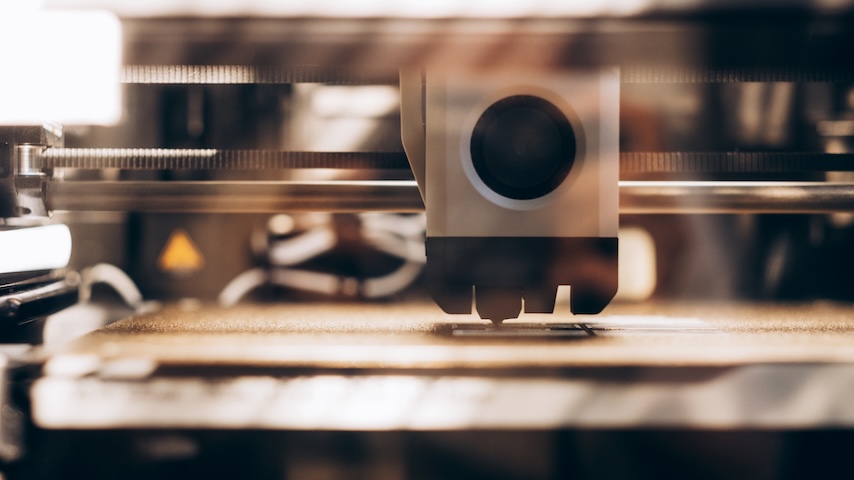
A new 3D printing technique utilizes light holograms to build intricate electronic structures in one step.
A nanoscale metasurface mask is the key to triggering polymer curing and metal formation simultaneously with a single beam of light, resulting in a new 3D printing method that has the potential to revolutionize the production of semiconductor chips, according to researchers at the University of Texas at Austin.
Unlike traditional additive manufacturing methods that rely on slow, layer-by-layer scanning, this new method, called holographic metasurface nano-lithography (HMNL), fuses metal and polymer features together inside a single volume of resin. By shaping light instead of moving hardware, the system eliminates mechanical scanning from the fabrication process and empowers chemistry and optics to dictate the final structure.
Using wavelength-selective chemistry, each hologram triggers independent reactions within the resin. Ultraviolet light reduces the metal salts into solid silver wires, while visible light solidifies the surrounding polymer. Because each reaction responds to a specific light wavelength, the holograms occupy the same physical space without interference. This chemical specificity enables complex conductors and insulators to form within a single exposure.
“We projected the 3D light intensity pattern into a photocurable resin. Where it’s exposed to high intensity UV light, the resin turns into a conductive metal, and where it’s exposed to lower intensity visible light, it turns into a polymer material,” Cullinan explained.
Listen to ASME TechCast: Making Additive the First Choice for Production
The metal salts remain transparent within the resin, permitting visible light to cure the polymer without disruption. Once exposed to UV light, the metal begins to form and block visible light. By carefully tuning light intensity and timing, that's when the polymer forms, followed by the metal.
“Polymer curing is a photo radical initiated process, which is very fast compared to the thermal process the metal uses. Generally, the polymer will form first, and then the metal starts to heat up and form in the place where the high intensity UV light projects,” Cullinan explained.
However, projecting the hologram into the resin also results in an ellipsoidal distortion that initially threatened dimensional accuracy. To correct this and increase contrast, the team used four overlapping holograms: One pair of UV and visible light beams approached from one angle, while a second pair entered at a 90-degree angle to the first. The overlapping regions increased resolution, leading to more precise printing.
The researchers are already working to commercialize the technology through a startup, Texas Microsintering Inc., founded by team leader Michael Cullinan, associate professor in the Walker Department of Mechanical Engineering at UT Austin.
A $14.5 million grant from the Defense Advanced Research Projects Agency (DARPA) supported the effort and brought together academic and industry partners. Researchers at the University of Texas at Austin collaborated with the University of Utah, Applied Materials, Bright Silicon Technologies, Electroninks, Northrop Grumman, NXP Semiconductors, and Texas Microsintering.
HMNL fundamentally changes this delivery by projecting the entire 3D volume at once through the holographic metamask. This shift cuts a multi-step process down to one or two steps and achieves production speeds thousands of times faster than the scanning-based TPP approach. While HMNL solves the speed issues of TPP, it also overcomes the geometric constraints of traditional semi-additive manufacturing.
Discover the Benefits of ASME Membership
Standard semi-additive processes typically forces wires to follow an “up and over” path that creates interconnects at every change in direction. In contrast, HMNL allows designers to create free-form wire paths. These paths take a more direct route from point to point, which reduces the time electrons required to pass through the circuit. Early testing of these direct pathways showed significant performance benefits, including faster electron transfer, less heat generation, and smaller power requirements.
HMNL fills a critical gap in the chiplet economy by supporting low- and mid-volume production runs. While large offshore assembly and test facilities demand million-unit orders to justify tooling and setup costs, HMNL sustains a high-mix manufacturing model that favors customization over scale.
“Traditional packaging processes demand high costs for low or mid-volume runs. Directly printing those interconnect structures opens a pathway for designers to customize assemblies more easily,” Cullinan explained.
This direct-printing approach lowers barriers for custom electronics and enables smaller firms room to innovate in high-performance computing and defense applications.
Nicole Imeson is an engineer and writer in Calgary, Alberta.
Unlike traditional additive manufacturing methods that rely on slow, layer-by-layer scanning, this new method, called holographic metasurface nano-lithography (HMNL), fuses metal and polymer features together inside a single volume of resin. By shaping light instead of moving hardware, the system eliminates mechanical scanning from the fabrication process and empowers chemistry and optics to dictate the final structure.
Metamask and resin
To create the metamask, researchers started with the desired 3D object. Then, using powerful computational models, the team worked backward to calculate the exact nanopillar topography needed to generate that specific 3D light field. This process resulted in an ultra-thin glass surface covered with millions of microscopic pillars. When light passes through the metamask, the pillars warp light into a precise 3D hologram. Researchers then projected the hologram into a photocurable resin containing polymer monomers and metal salts.Using wavelength-selective chemistry, each hologram triggers independent reactions within the resin. Ultraviolet light reduces the metal salts into solid silver wires, while visible light solidifies the surrounding polymer. Because each reaction responds to a specific light wavelength, the holograms occupy the same physical space without interference. This chemical specificity enables complex conductors and insulators to form within a single exposure.
“We projected the 3D light intensity pattern into a photocurable resin. Where it’s exposed to high intensity UV light, the resin turns into a conductive metal, and where it’s exposed to lower intensity visible light, it turns into a polymer material,” Cullinan explained.
Listen to ASME TechCast: Making Additive the First Choice for Production
The metal salts remain transparent within the resin, permitting visible light to cure the polymer without disruption. Once exposed to UV light, the metal begins to form and block visible light. By carefully tuning light intensity and timing, that's when the polymer forms, followed by the metal.
“Polymer curing is a photo radical initiated process, which is very fast compared to the thermal process the metal uses. Generally, the polymer will form first, and then the metal starts to heat up and form in the place where the high intensity UV light projects,” Cullinan explained.
However, projecting the hologram into the resin also results in an ellipsoidal distortion that initially threatened dimensional accuracy. To correct this and increase contrast, the team used four overlapping holograms: One pair of UV and visible light beams approached from one angle, while a second pair entered at a 90-degree angle to the first. The overlapping regions increased resolution, leading to more precise printing.
The researchers are already working to commercialize the technology through a startup, Texas Microsintering Inc., founded by team leader Michael Cullinan, associate professor in the Walker Department of Mechanical Engineering at UT Austin.
A $14.5 million grant from the Defense Advanced Research Projects Agency (DARPA) supported the effort and brought together academic and industry partners. Researchers at the University of Texas at Austin collaborated with the University of Utah, Applied Materials, Bright Silicon Technologies, Electroninks, Northrop Grumman, NXP Semiconductors, and Texas Microsintering.
Improvement over traditional methods
Traditional two-photon polymerization (TPP) offers incredible precision but moves painstakingly slow. This process relies on a laser focusing its energy on a tiny point within liquid resin to solidify a single “voxel” or 3D pixel at a time. The system scans this point across a 2D plane to form a layer, raises the focal point slightly, and repeats the process to stack the next layer. Because TPP requires the laser to “draw” every single line of a part, manufacturing complex structures takes significant time.HMNL fundamentally changes this delivery by projecting the entire 3D volume at once through the holographic metamask. This shift cuts a multi-step process down to one or two steps and achieves production speeds thousands of times faster than the scanning-based TPP approach. While HMNL solves the speed issues of TPP, it also overcomes the geometric constraints of traditional semi-additive manufacturing.
Discover the Benefits of ASME Membership
Standard semi-additive processes typically forces wires to follow an “up and over” path that creates interconnects at every change in direction. In contrast, HMNL allows designers to create free-form wire paths. These paths take a more direct route from point to point, which reduces the time electrons required to pass through the circuit. Early testing of these direct pathways showed significant performance benefits, including faster electron transfer, less heat generation, and smaller power requirements.
Large scale production
Despite its advantages over TPP and semi-additive processes, HMNL has encountered obstacles on the path to large-scale production and industry adoption. The research team is prioritizing additional testing to verify print-to-print consistency and long-term performance across operating environments.HMNL fills a critical gap in the chiplet economy by supporting low- and mid-volume production runs. While large offshore assembly and test facilities demand million-unit orders to justify tooling and setup costs, HMNL sustains a high-mix manufacturing model that favors customization over scale.
“Traditional packaging processes demand high costs for low or mid-volume runs. Directly printing those interconnect structures opens a pathway for designers to customize assemblies more easily,” Cullinan explained.
This direct-printing approach lowers barriers for custom electronics and enables smaller firms room to innovate in high-performance computing and defense applications.
Nicole Imeson is an engineer and writer in Calgary, Alberta.


Stay up to date on the advances in additive manufacturing. This collection highlights new applications of 3D printing, metal printing methods, materials development, medical devices, and bioprinting.