Superconductors Reimagined
Superconductors Reimagined
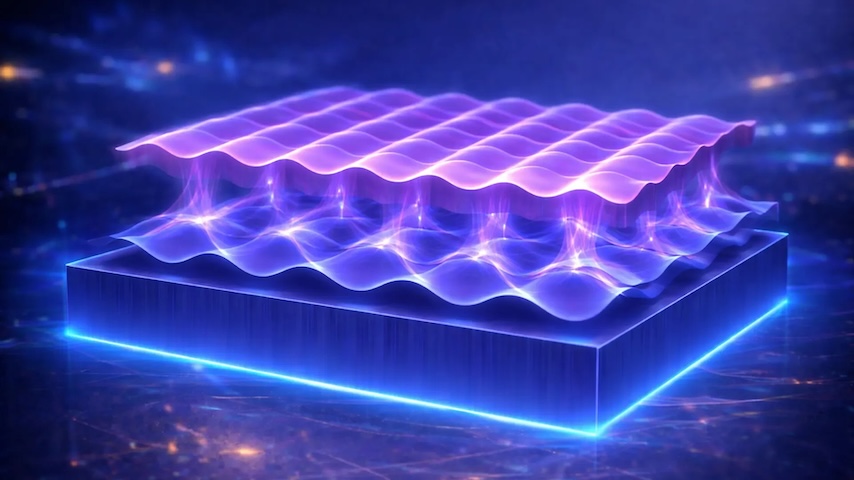
A new solution that could realize superconductors’ potential to deliver zero-resistance power under real-world conditions. The answer lies in the substrate.
It seems like everyone today has a cell phone in their hand, a habit that carries unseen energy implications. Production and use of digital devices, data centers, and information and communications technology networks now account for roughly six to 12 percent of global electricity consumption, according to UN Trade and Development estimates.
The energy demand of the devices powering modern life has spurred a search for more efficient technologies. Among the most promising candidates are superconductors—materials capable of carrying electricity with zero resistance. Yet despite decades of research, a thorny challenge has remained: enabling superconductivity to operate at higher temperatures while also withstanding strong magnetic fields, conditions necessary for real-world applications.
Now, researchers at Sweden’s Chalmers University of Technology say they have taken a step toward solving that problem, using an approach that rethinks how superconducting materials are designed from the ground up.
“Our motivation was to find a new way to control and strengthen superconductivity in cuprates,” explained Floriana Lombardi, a professor of quantum device physics and lead author of “Boosting superconductivity in ultrathin YBa2Cu3O7−δ films via nanofaceted substrates.” Cuprates, a family of copper-oxide materials, hold the record for the highest superconducting temperatures at ambient pressure. “Even so, those temperatures are still far too low for many practical applications,” she says, noting they remain more than 140 ºC below freezing.
The problem is not just temperature. Superconductivity is also fragile in the presence of strong magnetic fields, which are essential in technologies such as particle accelerators and advanced electronics. Together, these limitations have kept superconductors largely confined to specialized environments requiring complex and costly cooling systems.
To address this, the Chalmers team focused on a fundamental issue: the lack of tunability in cuprate materials. Unlike many modern two-dimensional materials, their electronic properties are essentially fixed during fabrication and cannot easily be adjusted afterward.
“That pushed us to look for another route,” explained assistant professor Riccardo Arpaia. “In this work we show that the substrate itself can become an active way to reshape the superconducting state.”
Instead of altering the chemical composition of the superconducting material, the researchers engineered the surface on which the material is grown. This substrate, typically considered a passive support, became the focus of their approach.
The team worked with ultrathin films—just 10 nanometers thick—of a cuprate superconductor called YBCO (yttrium barium copper oxide). These films were deposited onto magnesium oxide substrates that had been pre-treated at high temperatures in a vacuum.
More for You: Pressure Quenching Superconductors
That pre-treatment led to an unexpected transformation.
“The first key moment was realizing that the heating process was dramatically reshaping the initially flat substrate surface,” Arpaia explained. “The surface developed nanoscale ridges and valleys, forming what he described as a miniature “desert-canyon landscape.”
Rather than treating this texture as a defect, the researchers leaned into it. The nanoscale pattern created a new electronic environment at the interface between the substrate and the superconducting film.
The results showed that compared to thicker films, the ultrathin layers grown on these nanostructured surfaces showed a superconducting onset temperature that was 15 to 20 Kelvin higher. They also demonstrated an ability to withstand magnetic fields more than 50 tesla stronger than comparable samples.
“The second, and probably even bigger surprise, was discovering that the thinnest films were actually performing better,” Arpaia said. “At that point, it became clear that the substrate was not acting as a passive support, but as an active element.”
At the microscopic level, the engineered interface altered how electrons behaved. They developed direction-dependent properties that reshaped the superconducting state, enhancing its properties,” Lombardi added. “We could see how the electrons’ properties began to stabilize and strengthen superconductivity.”
The researchers describe the work as a proof-of-principle rather than a finished technology. The team fabricated and tested multiple film configurations, along with patterned devices for transport measurements under high magnetic fields, but has not yet developed commercial prototypes.
Still, the implications could be far-reaching especially as data center construction continues and demand increases. There are currently 11,038 data centers globally located in 174 countries, and demand is expected to nearly triple by 2030.
“With numbers of data centers growing, energy-efficient electronics are becoming a major technological priority,” Arpaia said.
Discover the Benefits of ASME Membership
Superconductors could dramatically reduce the energy lost as heat in electronic systems, making everything from power grids to quantum computers far more efficient, he added.
The research also introduces a new design principle—that superconductivity can be enhanced not only through chemistry, but through nanoscale engineering of the interface between materials.
“Instead of searching for entirely new materials, we are showing how superconductivity can be improved by sculpting the substrate,” Lombardi said.
Looking ahead, the team plans to expand this approach beyond cuprates, exploring whether similar substrate-engineering techniques can be applied to other quantum materials.
“The next step is to turn this concept into a broader design strategy,” Lombardi says, including optimizing nanopatterning and moving closer to device-ready platforms.
If successful, the approach could lead to superconductors that operate closer to room temperature and under realistic conditions—an advance that could transform energy use in an increasingly digital world.
Annemarie Mannion is a technology writer in Chicago.
The energy demand of the devices powering modern life has spurred a search for more efficient technologies. Among the most promising candidates are superconductors—materials capable of carrying electricity with zero resistance. Yet despite decades of research, a thorny challenge has remained: enabling superconductivity to operate at higher temperatures while also withstanding strong magnetic fields, conditions necessary for real-world applications.
Now, researchers at Sweden’s Chalmers University of Technology say they have taken a step toward solving that problem, using an approach that rethinks how superconducting materials are designed from the ground up.
“Our motivation was to find a new way to control and strengthen superconductivity in cuprates,” explained Floriana Lombardi, a professor of quantum device physics and lead author of “Boosting superconductivity in ultrathin YBa2Cu3O7−δ films via nanofaceted substrates.” Cuprates, a family of copper-oxide materials, hold the record for the highest superconducting temperatures at ambient pressure. “Even so, those temperatures are still far too low for many practical applications,” she says, noting they remain more than 140 ºC below freezing.
Substrate solutions
The problem is not just temperature. Superconductivity is also fragile in the presence of strong magnetic fields, which are essential in technologies such as particle accelerators and advanced electronics. Together, these limitations have kept superconductors largely confined to specialized environments requiring complex and costly cooling systems.
To address this, the Chalmers team focused on a fundamental issue: the lack of tunability in cuprate materials. Unlike many modern two-dimensional materials, their electronic properties are essentially fixed during fabrication and cannot easily be adjusted afterward.
“That pushed us to look for another route,” explained assistant professor Riccardo Arpaia. “In this work we show that the substrate itself can become an active way to reshape the superconducting state.”
Instead of altering the chemical composition of the superconducting material, the researchers engineered the surface on which the material is grown. This substrate, typically considered a passive support, became the focus of their approach.
The team worked with ultrathin films—just 10 nanometers thick—of a cuprate superconductor called YBCO (yttrium barium copper oxide). These films were deposited onto magnesium oxide substrates that had been pre-treated at high temperatures in a vacuum.
More for You: Pressure Quenching Superconductors
That pre-treatment led to an unexpected transformation.
“The first key moment was realizing that the heating process was dramatically reshaping the initially flat substrate surface,” Arpaia explained. “The surface developed nanoscale ridges and valleys, forming what he described as a miniature “desert-canyon landscape.”
Rather than treating this texture as a defect, the researchers leaned into it. The nanoscale pattern created a new electronic environment at the interface between the substrate and the superconducting film.
The results showed that compared to thicker films, the ultrathin layers grown on these nanostructured surfaces showed a superconducting onset temperature that was 15 to 20 Kelvin higher. They also demonstrated an ability to withstand magnetic fields more than 50 tesla stronger than comparable samples.
“The second, and probably even bigger surprise, was discovering that the thinnest films were actually performing better,” Arpaia said. “At that point, it became clear that the substrate was not acting as a passive support, but as an active element.”
At the microscopic level, the engineered interface altered how electrons behaved. They developed direction-dependent properties that reshaped the superconducting state, enhancing its properties,” Lombardi added. “We could see how the electrons’ properties began to stabilize and strengthen superconductivity.”
Powerful promise
The researchers describe the work as a proof-of-principle rather than a finished technology. The team fabricated and tested multiple film configurations, along with patterned devices for transport measurements under high magnetic fields, but has not yet developed commercial prototypes.
Still, the implications could be far-reaching especially as data center construction continues and demand increases. There are currently 11,038 data centers globally located in 174 countries, and demand is expected to nearly triple by 2030.
“With numbers of data centers growing, energy-efficient electronics are becoming a major technological priority,” Arpaia said.
Discover the Benefits of ASME Membership
Superconductors could dramatically reduce the energy lost as heat in electronic systems, making everything from power grids to quantum computers far more efficient, he added.
The research also introduces a new design principle—that superconductivity can be enhanced not only through chemistry, but through nanoscale engineering of the interface between materials.
“Instead of searching for entirely new materials, we are showing how superconductivity can be improved by sculpting the substrate,” Lombardi said.
Looking ahead, the team plans to expand this approach beyond cuprates, exploring whether similar substrate-engineering techniques can be applied to other quantum materials.
“The next step is to turn this concept into a broader design strategy,” Lombardi says, including optimizing nanopatterning and moving closer to device-ready platforms.
If successful, the approach could lead to superconductors that operate closer to room temperature and under realistic conditions—an advance that could transform energy use in an increasingly digital world.
Annemarie Mannion is a technology writer in Chicago.


Explore ASME's commitment to sustainability, addressing climate challenges through innovation, policy, & workforce development. Get informed and involved!