Hydrogen Hits the Rails
Hydrogen Hits the Rails
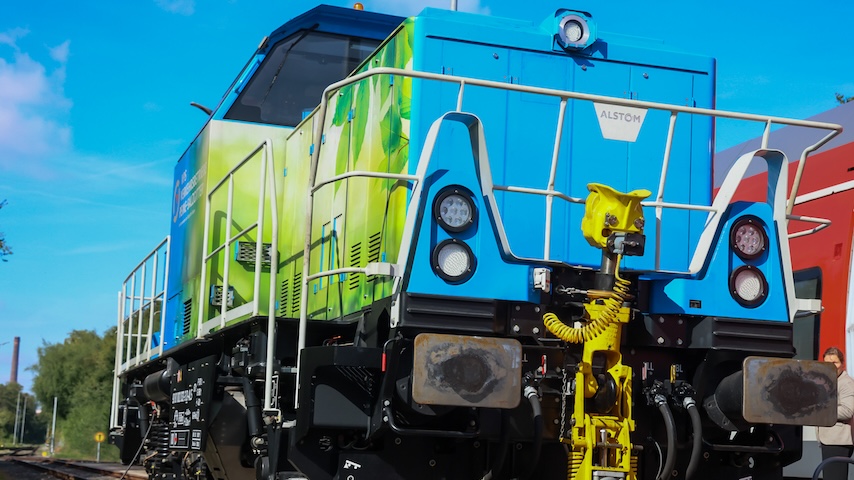
Shunting locomotives converted from diesel to hydrogen drives perform the same as before, without the emissions.
The greener and cleaner vehicle revolution—if that’s what you want to call it—works best on massive scales. Electric cars, to take the most obvious for-instance, are being produced by the millions. Trains, too, are going electric. In Europe, 60 percent of all trains have been electrified.
But at smaller scales, conversions are tougher. In Germany, for example, diesel locomotives still do most of the work in shunting yards. The folks at train-making giant, Alstom, wanted to change that.
Though electrification isn’t in the plans for shunting yards, the tax for using fossil fuels is. So there needs to be another green option for Europe’s 4,000-odd shunting engines, many of which have decades of life ahead of them.
“We have to find a solution for the existing vehicles on the market. Because that’s a big thing for our customers, that they can use their assets much longer,” said Alstom’s project manager Oliver Mairinger. “The idea was okay, what could be the smallest influence on the whole vehicle.”
The answer was to turn those diesel burning engines into hydrogen burning engines. Starting in early 2022, the company set out to find the best way to do that in a joint research project with The Technical University of Braunschweig, the research institute WTZ Rosslau, and the shunting operator VPS.
More for You: Biofuel Could Become Hydrogen Carrier
The chief challenge was dealing with the fact that hydrogen requires twice as much air as diesel for combustion and that it needs to be mixed as homogeneously as possible to avoid pre-ignition events and engine knocking. For that, the engines required a much larger turbocharger.
Alstom also had to cut down the piston and adapt the cylinder head. To deal with the greater heat of the exhaust, the cooling system had to be modified. And, where diesel is self-igniting, hydrogen needs a little help, so an ignition light had to be added inside the chamber and the ECU had to be tweaked.
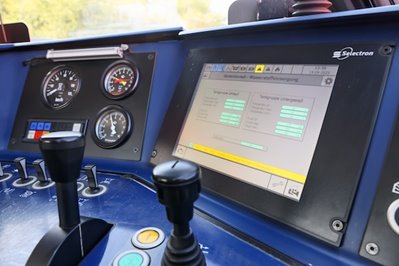 The fill level and temperature of the new hydrogen storage tank can be read on the driver’s screen. Photo: Philipp Ziebart/Alstom
Solving most of these problems did not mean designing ideal components from scratch but finding the most appropriate off-the-shelf parts.
The fill level and temperature of the new hydrogen storage tank can be read on the driver’s screen. Photo: Philipp Ziebart/Alstom
Solving most of these problems did not mean designing ideal components from scratch but finding the most appropriate off-the-shelf parts.
“So, the idea was not to design anything new, because this is something the project budget did not provide for, to be honest,” Mairinger said. “We did some mixture simulations within the chamber, just to make sure that the ignition and mixture is as good as it could be. And then, with the data we gained, we went to several suppliers of turbochargers and decided which kind of product available on the market would fit the engine best.”
However ingenious the solutions to doctoring a diesel engine to burn hydrogen, those technical tricks were secondary to the challenge of making sure the engine was safe to drive.
“This is the first time a shunting locomotive is using a diesel engine which is adapted for hydrogen,” Mairinger explained. “And it was a big, big challenge to make sure that the engine itself is safe in any manner and in any failure mode we could face.”
Discover the Benefits of ASME Membership
To avoid oil fires, unwanted hydrogen ignition, and backfire in the exhaust, Mairinger’s team set out to sense and prevent every possible hazard. They developed a “chamber observation system” with sensors in the engine to monitor pressure during ignition and burning phases. If an injector malfunctions, the engine shuts down immediately.
The final, safe, hydrogen-powered locomotive made its maiden voyage in September 2025.
“I remember well, the expression on others’ faces when the loco first took off,” said Jörn Bischoff, Alstom’s media relations manager. “It was a moment that everybody that was a part of this project took great pride in.”
After that initial trip, the engine went straight to the partnering customer who had offered up his locomotive for hydrogen testing. And since then, it’s been doing its shunting, powered by hydrogen, without issue, though it noticeably smells better than it did when burning diesel.
“I think the best compliment we got from the train driver is that the usage of the loco is exactly the same as before,” said Bischoff.
That customer happened to have his shunting yard near one of Alstom’s production sites, so when he needs to refuel, he can come by to top off his tank. The rest of Germany—and Europe—does not have such ready access to the fuel, so it may be some time before other diesel-powered engines go through a similar conversion.
“The intention of the R&D project was to integrate and adapt an engine on the locomotive, and to just see if this kind of technology is a way to go or not,” Mairinger said. “So, there was not really any optimization for a serial product yet. But to be honest, the best and the biggest finding is that the engine is reliable from today’s point of view.”
Michael Abrams is a technology writer in Westfield, N.J.
But at smaller scales, conversions are tougher. In Germany, for example, diesel locomotives still do most of the work in shunting yards. The folks at train-making giant, Alstom, wanted to change that.
Though electrification isn’t in the plans for shunting yards, the tax for using fossil fuels is. So there needs to be another green option for Europe’s 4,000-odd shunting engines, many of which have decades of life ahead of them.
“We have to find a solution for the existing vehicles on the market. Because that’s a big thing for our customers, that they can use their assets much longer,” said Alstom’s project manager Oliver Mairinger. “The idea was okay, what could be the smallest influence on the whole vehicle.”
The answer was to turn those diesel burning engines into hydrogen burning engines. Starting in early 2022, the company set out to find the best way to do that in a joint research project with The Technical University of Braunschweig, the research institute WTZ Rosslau, and the shunting operator VPS.
More for You: Biofuel Could Become Hydrogen Carrier
The chief challenge was dealing with the fact that hydrogen requires twice as much air as diesel for combustion and that it needs to be mixed as homogeneously as possible to avoid pre-ignition events and engine knocking. For that, the engines required a much larger turbocharger.
Alstom also had to cut down the piston and adapt the cylinder head. To deal with the greater heat of the exhaust, the cooling system had to be modified. And, where diesel is self-igniting, hydrogen needs a little help, so an ignition light had to be added inside the chamber and the ECU had to be tweaked.
The fill level and temperature of the new hydrogen storage tank can be read on the driver’s screen. Photo: Philipp Ziebart/Alstom
“So, the idea was not to design anything new, because this is something the project budget did not provide for, to be honest,” Mairinger said. “We did some mixture simulations within the chamber, just to make sure that the ignition and mixture is as good as it could be. And then, with the data we gained, we went to several suppliers of turbochargers and decided which kind of product available on the market would fit the engine best.”
However ingenious the solutions to doctoring a diesel engine to burn hydrogen, those technical tricks were secondary to the challenge of making sure the engine was safe to drive.
“This is the first time a shunting locomotive is using a diesel engine which is adapted for hydrogen,” Mairinger explained. “And it was a big, big challenge to make sure that the engine itself is safe in any manner and in any failure mode we could face.”
Discover the Benefits of ASME Membership
To avoid oil fires, unwanted hydrogen ignition, and backfire in the exhaust, Mairinger’s team set out to sense and prevent every possible hazard. They developed a “chamber observation system” with sensors in the engine to monitor pressure during ignition and burning phases. If an injector malfunctions, the engine shuts down immediately.
The final, safe, hydrogen-powered locomotive made its maiden voyage in September 2025.
“I remember well, the expression on others’ faces when the loco first took off,” said Jörn Bischoff, Alstom’s media relations manager. “It was a moment that everybody that was a part of this project took great pride in.”
After that initial trip, the engine went straight to the partnering customer who had offered up his locomotive for hydrogen testing. And since then, it’s been doing its shunting, powered by hydrogen, without issue, though it noticeably smells better than it did when burning diesel.
“I think the best compliment we got from the train driver is that the usage of the loco is exactly the same as before,” said Bischoff.
That customer happened to have his shunting yard near one of Alstom’s production sites, so when he needs to refuel, he can come by to top off his tank. The rest of Germany—and Europe—does not have such ready access to the fuel, so it may be some time before other diesel-powered engines go through a similar conversion.
“The intention of the R&D project was to integrate and adapt an engine on the locomotive, and to just see if this kind of technology is a way to go or not,” Mairinger said. “So, there was not really any optimization for a serial product yet. But to be honest, the best and the biggest finding is that the engine is reliable from today’s point of view.”
Michael Abrams is a technology writer in Westfield, N.J.


Explore ASME's commitment to sustainability, addressing climate challenges through innovation, policy, & workforce development. Get informed and involved!