Researchers Rethink Titanium Implants Using Metamaterials
Researchers Rethink Titanium Implants Using Metamaterials

Researchers are redesigning titanium implants with metamaterial structures that better match the stiffness of bone, a shift that could reduce implant failures and improve patient recovery.
Titanium implants have long been favored in reconstructive and orthopedic surgery, but their very high strength can become a liability. Because titanium alloys are significantly stiffer than human bone, they tend to absorb most of the mechanical load from everyday actions like walking, chewing, or speaking. The resulting imbalance in load redistribution can lead to a phenomenon known as stress shielding, in which the surrounding bone weakens and gradually deteriorates.
For many patients, the unhappy result is implant failure and the need for revision surgeries—an outcome that adds physical, emotional, and financial strain.
Now, researchers at the University of Groningen in the Netherlands have developed a solution: reengineering implants not by changing the material, but by redesigning their internal structure. Their work, published recently in the journal Small Structures, focuses on metamaterials—engineered composites with properties depending more on their geometry than their composition.
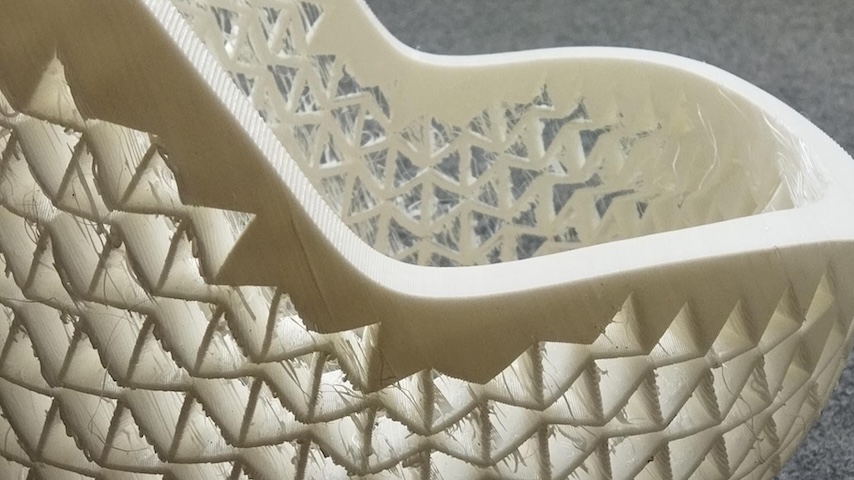
By carefully designing microscopic structural elementary blocks known as unit cells, scientists can fine tune how an implant behaves under stress, potentially matching the stiffness of bone far more closely than conventional solid titanium.
Their findings reveal that the mechanical behavior of metamaterials depends not only on the design of individual unit cells, but also on the number of cells used and how they are arranged. This size effect plays a critical role in determining properties such as elasticity and load distribution—key factors for medical implants.
 Traditional solid titanium implants are valued for strength, durability, and biocompatibility. So, rather than replacing titanium, the researchers sought to retain it and modify its architecture.
“We want to preserve titanium, but we want to remove effects that come from the excessive strength and stiffness of titanium,” said Anastasiia Krushynska, adjunct professor in the Faculty of Science and Engineering of the University of Groningen. “And for that research, we needed to evaluate the size effect. If you use already adopted materials and change the structure so that they do not have adverse effects on human bones, then it’s a preferred direction for medical implants.”
Researchers created a porous, lattice-like structure that reduces stiffness while maintaining strength. Achieving the right balance required years of research, advanced modeling, and extensive testing.
The broader project (backed by the Just Transition Fund program IMPACT-implants, coordinated by Samenwerkingsverband Noord-Nederland) began in 2023 and built on earlier exploratory work. The newest investigation into size effects took place in 2024 and 2025, during which time researchers developed both computational models and physical prototypes to validate their findings.
The project was a shift in focus for PhD student Shyam Veluvali at the University of Groningen who was intrigued by its tangible aspects.
“My background is in physics and applied mathematics, and I did not study anything related to something physical like this,” he said. “When I heard about this Ph.D. project, it sounded very practical because it’s with medical science and implants—something you can really touch and make. And it involves a lot of mathematical modeling. That was my motivation to be part of this research.”
Veluvali led the modeling and prototyping work, using computer-aided design tools and translating them into physical 3D-printed samples. In total, the team produced at least 30 prototypes for different mechanical lab experiments.
The process came with challenges. Veluvali had to quickly develop expertise in mechanical engineering concepts, simulation software, and an intuitive understanding of how materials behave under different forces. “It took quite some time for me to ask the right questions for understanding the size effects,” he said. “And sometimes we saw anomalous behavior—structures becoming stiffer or softer in unexpected ways—so making sense of that was challenging.”
While earlier studies often focused on a single type of stress, such as compression, this research examined multiple forces, including shear, compression, and torsion. The results showed that the same structure can behave differently under different conditions, adding another layer of complexity—but also opportunity—for design.
One of the project’s gratifying moments came when early experimental results matched computer simulations. “To see that what we simulated actually appeared in real experiments was really nice,” Veluvali said.
The implications extend far beyond dental or mandibular implants, where stress shielding affects an estimated 15 to 20 percent of cases. In orthopedic implants, such as those used in the legs, the rate can reach up to 30 percent due to higher biomechanical loads. By tailoring implant stiffness to match bone stiffness, researchers hope to reduce these failure rates.
Clinical trials are now being prepared, with the University Medical Center Groningen (UMCG) leading the clinical phase. While specific timelines are confidential, Krushynska said the technology is already at an advanced stage of development.
Beyond medicine, the findings about size effects in metamaterials could influence a wide range of industries. Potential applications include lightweight aerospace components, robotic grippers capable of handling delicate objects, vibration-damping systems, and even wearable products like customized shoe soles.
Still, each application will require its own tailored design. “Even if we know how to design metamaterials for one type of implant, for another application we need to start from the beginning,” Krushynska said. “We look at the requirements, design the material, test it, and then offer it as a solution.”
Ultimately, the goal is not just better materials, but better outcomes. “We want to improve patients’ lives, minimize the workload on hospitals, and make recovery smoother without complications,” Krushynska said. “If patients can undergo treatment once instead of twice, that’s a major benefit.”
Annemarie Mannion is a technology writer in Chicago.
For many patients, the unhappy result is implant failure and the need for revision surgeries—an outcome that adds physical, emotional, and financial strain.
Now, researchers at the University of Groningen in the Netherlands have developed a solution: reengineering implants not by changing the material, but by redesigning their internal structure. Their work, published recently in the journal Small Structures, focuses on metamaterials—engineered composites with properties depending more on their geometry than their composition.
Rethinking titanium
By carefully designing microscopic structural elementary blocks known as unit cells, scientists can fine tune how an implant behaves under stress, potentially matching the stiffness of bone far more closely than conventional solid titanium.Their findings reveal that the mechanical behavior of metamaterials depends not only on the design of individual unit cells, but also on the number of cells used and how they are arranged. This size effect plays a critical role in determining properties such as elasticity and load distribution—key factors for medical implants.
Metamaterials Make for a Safer Bicycle Helmet
Researchers at the University of Gothenburg have developed an improved bicycle helmet.
“We want to preserve titanium, but we want to remove effects that come from the excessive strength and stiffness of titanium,” said Anastasiia Krushynska, adjunct professor in the Faculty of Science and Engineering of the University of Groningen. “And for that research, we needed to evaluate the size effect. If you use already adopted materials and change the structure so that they do not have adverse effects on human bones, then it’s a preferred direction for medical implants.”
Researchers created a porous, lattice-like structure that reduces stiffness while maintaining strength. Achieving the right balance required years of research, advanced modeling, and extensive testing.
The broader project (backed by the Just Transition Fund program IMPACT-implants, coordinated by Samenwerkingsverband Noord-Nederland) began in 2023 and built on earlier exploratory work. The newest investigation into size effects took place in 2024 and 2025, during which time researchers developed both computational models and physical prototypes to validate their findings.
The project was a shift in focus for PhD student Shyam Veluvali at the University of Groningen who was intrigued by its tangible aspects.
“My background is in physics and applied mathematics, and I did not study anything related to something physical like this,” he said. “When I heard about this Ph.D. project, it sounded very practical because it’s with medical science and implants—something you can really touch and make. And it involves a lot of mathematical modeling. That was my motivation to be part of this research.”
Testing metamaterials
Veluvali led the modeling and prototyping work, using computer-aided design tools and translating them into physical 3D-printed samples. In total, the team produced at least 30 prototypes for different mechanical lab experiments.The process came with challenges. Veluvali had to quickly develop expertise in mechanical engineering concepts, simulation software, and an intuitive understanding of how materials behave under different forces. “It took quite some time for me to ask the right questions for understanding the size effects,” he said. “And sometimes we saw anomalous behavior—structures becoming stiffer or softer in unexpected ways—so making sense of that was challenging.”
While earlier studies often focused on a single type of stress, such as compression, this research examined multiple forces, including shear, compression, and torsion. The results showed that the same structure can behave differently under different conditions, adding another layer of complexity—but also opportunity—for design.
One of the project’s gratifying moments came when early experimental results matched computer simulations. “To see that what we simulated actually appeared in real experiments was really nice,” Veluvali said.
Better implants
The implications extend far beyond dental or mandibular implants, where stress shielding affects an estimated 15 to 20 percent of cases. In orthopedic implants, such as those used in the legs, the rate can reach up to 30 percent due to higher biomechanical loads. By tailoring implant stiffness to match bone stiffness, researchers hope to reduce these failure rates.Clinical trials are now being prepared, with the University Medical Center Groningen (UMCG) leading the clinical phase. While specific timelines are confidential, Krushynska said the technology is already at an advanced stage of development.
Beyond medicine, the findings about size effects in metamaterials could influence a wide range of industries. Potential applications include lightweight aerospace components, robotic grippers capable of handling delicate objects, vibration-damping systems, and even wearable products like customized shoe soles.
Still, each application will require its own tailored design. “Even if we know how to design metamaterials for one type of implant, for another application we need to start from the beginning,” Krushynska said. “We look at the requirements, design the material, test it, and then offer it as a solution.”
Ultimately, the goal is not just better materials, but better outcomes. “We want to improve patients’ lives, minimize the workload on hospitals, and make recovery smoother without complications,” Krushynska said. “If patients can undergo treatment once instead of twice, that’s a major benefit.”
Annemarie Mannion is a technology writer in Chicago.
Researchers are redesigning titanium implants with metamaterial structures that better match the stiffness of bone, a shift that could reduce implant failures and improve patient recovery.

Freelance writer based in Chicago
Related Content

Jun 23, 2026
Defects to Boost Strength

New research into the tiniest of metals has revealed that defects can make a nanoscaled object stronger.
Jun 22, 2026
Blaze-Battling Bots Ahead


A novel system that uses AI-powered robots to extinguish fires could eliminate the need to put firefighters in dangerous situations.
.jpg?width=854&height=480&ext=.jpg)

Jun 19, 2026
Quiz: World Cup Tech, Turf, and Trivia

Test your knowledge of FIFA World Cup technology, turf science, and match-ball aerodynamics in this ASME quiz on the engineering behind soccer’s biggest event.

Jun 18, 2026
Superconductors Reimagined
Reimagined superconductors could deliver zero-resistance power under real-world conditions. The solution lies in the substrate.