The Push for Truly Autonomous Microrobots
The Push for Truly Autonomous Microrobots
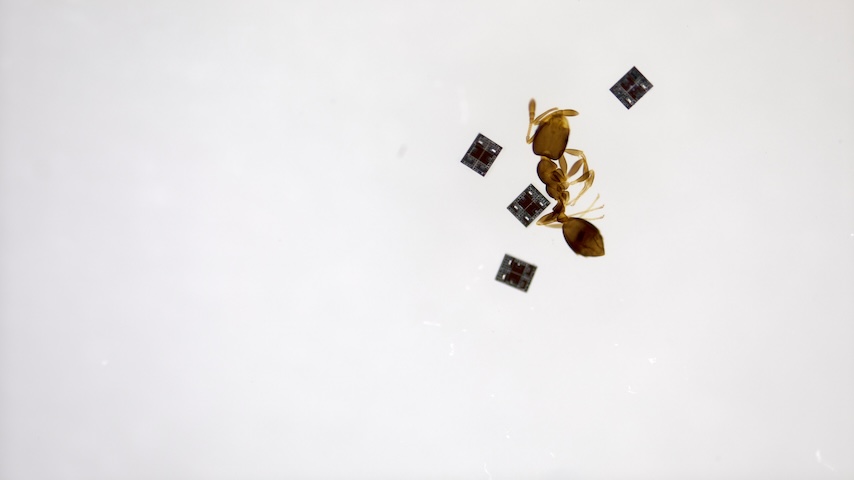
One of the latest microrobots on the scene packs sensing, computation, decision-making, power, and locomotion into a single sub-millimeter platform.
Roboticists have built machines that can fly like insects, grip like geckos, and drive themselves across warehouses and rugged terrain. But shrink the concept below a millimeter and the rules change fast. At that scale, a robot is no longer something a human can hold, steer, or even reliably see without a microscope.
This micro-realm is where Marc Miskin has spent his career. An assistant professor in Electrical and Systems Engineering at the University of Pennsylvania, Miskin’s lab focuses on robots sized for the physical territory normally occupied by cells and microorganisms. It is a world brimming with life, complexity, and consequence, yet largely inaccessible to direct human intervention.
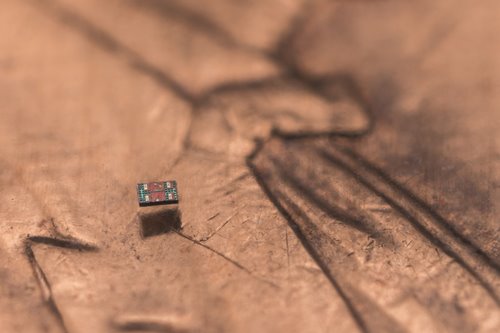 A microrobot sitting on the face of a penny. Photo: Michael Simari, University of Michigan
Although claims of the “world’s smallest robot” tend to invite skepticism, Miskin is quick to clarify that what matters most isn’t the adjective, it’s the noun.
A microrobot sitting on the face of a penny. Photo: Michael Simari, University of Michigan
Although claims of the “world’s smallest robot” tend to invite skepticism, Miskin is quick to clarify that what matters most isn’t the adjective, it’s the noun.
“The real loaded word here is actually robot,” he said. “Roboticists really don’t have a coherent definition of what a robot is, whereas with the word ‘computer’ you get a very clean answer.”
At the microscale, many devices have been labeled microrobots: magnetically guided beads, externally driven swimmers, and microactuators that respond to carefully controlled fields. These systems can be powerful tools, but most are not autonomous; they rely on bulky external equipment to guide their motion. On the other end of the spectrum are centimeter-scale machines that can act independently but are no longer truly “micro.”
“If you said, ‘I want something that can sense its environment, make its own decisions, have its own power supply, and move itself around the world without ever having to talk to a human again,’ then we’re the smallest anybody’s gotten so far,” Miskin said.
 The final stages of microrobot fabrication deploy hundreds of robots all at once. The tiny machines can then be programmed individually or en masse to carry out experiments. Photo: Maya Lassiter, University of Pennsylvania
A key enabler of that autonomy is the robot’s electrokinetic propulsion system, which Miskin explains using an analogy many engineers recognize: electrophoresis. Charged particles placed in an electric field move in response to that field. At the microscale, objects immersed in water naturally acquire surface charges through chemical interactions. When an electric field is applied, those charges—and their nearby counter-ions—experience forces that drag surrounding fluid along.
The final stages of microrobot fabrication deploy hundreds of robots all at once. The tiny machines can then be programmed individually or en masse to carry out experiments. Photo: Maya Lassiter, University of Pennsylvania
A key enabler of that autonomy is the robot’s electrokinetic propulsion system, which Miskin explains using an analogy many engineers recognize: electrophoresis. Charged particles placed in an electric field move in response to that field. At the microscale, objects immersed in water naturally acquire surface charges through chemical interactions. When an electric field is applied, those charges—and their nearby counter-ions—experience forces that drag surrounding fluid along.
The twist is that the robot generates this electric field itself, effectively “electrophoresing itself,” as Miskin puts it. The field pushes ions, the ions push water molecules, and the robot moves as if it has created its own flowing current.
The biggest advantage of this approach is controllability. Because speed scales directly with electric field strength, the robot’s propulsion behaves much like simplified wheels: modulate the field on one side and the robot turns; increase it uniformly and it accelerates forward. This simplicity is especially valuable when onboard memory and computational resources are extremely limited.
A second constraint is durability. Intuition suggests that something this small must be fragile, but Miskin’s answer is more nuanced. During fabrication, the robots are notoriously easy to destroy. They exist on brittle silicon wafers where a single mistake can shatter work in progress. Once released, however, they become surprisingly robust.
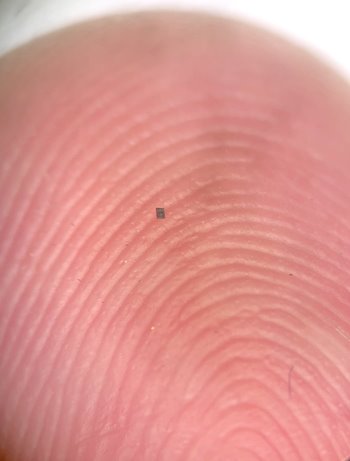 A microrobot, fully integrated with sensors and a computer, small enough to balance on the ridge of a fingerprint. Photo: Marc Miskin, University of Pennsylvania
Miskin jokingly referred to the finished devices as “designer sand,” as they’re mostly silicon and silicon dioxide. And like a grain of sand, a rigid structure at this scale is difficult to crush because human-applied forces are large, blunt, and unfocused.
A microrobot, fully integrated with sensors and a computer, small enough to balance on the ridge of a fingerprint. Photo: Marc Miskin, University of Pennsylvania
Miskin jokingly referred to the finished devices as “designer sand,” as they’re mostly silicon and silicon dioxide. And like a grain of sand, a rigid structure at this scale is difficult to crush because human-applied forces are large, blunt, and unfocused.
“If I told you to put a piece of sand on your finger and crush it with your other finger, good luck,” he said. “The amount of force you’d have to localize is huge.”
Power is the third major constraint. At sub-millimeter dimensions, energy storage is so limited that optimizing for efficiency often misses the point. A tiny battery might power a robot for minutes, not hours. As a result, the more practical solution is continuous energy transfer, shifting the key metric from efficiency to power consumption.
This reality also constrains operating voltages and currents to what miniature electronics can supply. An actuator that requires hundreds of volts may work in isolation, but it is effectively unusable in an autonomous microrobot.
Together, these rules point toward a broader strategy: developing a portfolio of actuation mechanisms optimized for different environments. High-conductivity biofluids, low-conductivity manufacturing liquids, and terrestrial surfaces each reshape the trade space, often introducing a fundamental tradeoff between force and speed. On land, adhesion and surface forces demand strength, but in fluids, speed and maneuverability may matter more.
Nature’s workaround is collective intelligence. Ant colonies and starling murmurations scale gracefully, functioning without any central awareness of how many individuals are involved. That robustness is exactly what makes swarm behavior compelling at the microscale, where “you really do have a million robots,” as Miskin explained it, and cannot address them individually.
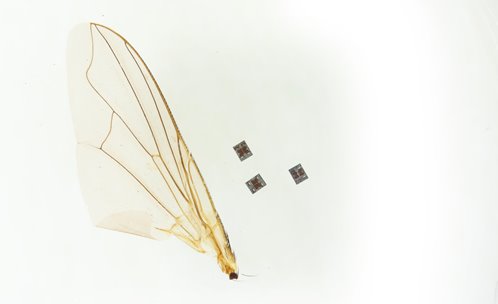 Three microrobots sitting next to an insect wing. Photo: Maya Lassiter, University of Pennsylvania
With this in mind, the group’s next holy grail is local communication. By enabling robots to exchange information directly, they could adapt programs and coordinate behavior through simple, local interactions.
Three microrobots sitting next to an insect wing. Photo: Maya Lassiter, University of Pennsylvania
With this in mind, the group’s next holy grail is local communication. By enabling robots to exchange information directly, they could adapt programs and coordinate behavior through simple, local interactions.
Near-term applications are most likely to emerge in medicine. Among the early concepts the group is exploring are sending microrobots to the base of root canals to verify successful procedures, applying controlled mechanical tension to encourage peripheral nerve regrowth, and eventually interacting with specific cells in targeted ways.
For those visions to become practical, two engineering hurdles loom large. One is safety and longevity, ensuring that robots can exist in the body without adverse effects over decades, not weeks. The other is power transfer and locomotion through tissue, with targets on the order of 10 centimeters of power delivery depth and roughly a millimeter per second in speed.
Those goals underscore the project’s dual identity: proof of possibility today and a systems-engineering roadmap for tomorrow. The robots may look like insignificant specks on their own, but the opportunities they can unlock collectively are anything but small.
Cassandra Kelly is a technology writer in Columbus, Ohio.
This micro-realm is where Marc Miskin has spent his career. An assistant professor in Electrical and Systems Engineering at the University of Pennsylvania, Miskin’s lab focuses on robots sized for the physical territory normally occupied by cells and microorganisms. It is a world brimming with life, complexity, and consequence, yet largely inaccessible to direct human intervention.
A tiny, complex package
The team’s latest design, which was made in partnership with David Blaauw and his lab at the University of Michigan, is a fully integrated microrobot that packs sensing, computation, decision-making, power, and locomotion into a single sub-millimeter platform. Once programmed, it operates autonomously, without continuous human guidance.
A microrobot sitting on the face of a penny. Photo: Michael Simari, University of Michigan
“The real loaded word here is actually robot,” he said. “Roboticists really don’t have a coherent definition of what a robot is, whereas with the word ‘computer’ you get a very clean answer.”
At the microscale, many devices have been labeled microrobots: magnetically guided beads, externally driven swimmers, and microactuators that respond to carefully controlled fields. These systems can be powerful tools, but most are not autonomous; they rely on bulky external equipment to guide their motion. On the other end of the spectrum are centimeter-scale machines that can act independently but are no longer truly “micro.”
“If you said, ‘I want something that can sense its environment, make its own decisions, have its own power supply, and move itself around the world without ever having to talk to a human again,’ then we’re the smallest anybody’s gotten so far,” Miskin said.
The final stages of microrobot fabrication deploy hundreds of robots all at once. The tiny machines can then be programmed individually or en masse to carry out experiments. Photo: Maya Lassiter, University of Pennsylvania
The twist is that the robot generates this electric field itself, effectively “electrophoresing itself,” as Miskin puts it. The field pushes ions, the ions push water molecules, and the robot moves as if it has created its own flowing current.
The biggest advantage of this approach is controllability. Because speed scales directly with electric field strength, the robot’s propulsion behaves much like simplified wheels: modulate the field on one side and the robot turns; increase it uniformly and it accelerates forward. This simplicity is especially valuable when onboard memory and computational resources are extremely limited.
Sizable limitations
Working at this scale, however, means living within severe constraints. The first is manufacturability. Any actuator or structure must be compatible with scalable, tightly controlled processes such as photolithography, deposition, and etching—methods borrowed from semiconductor fabrication. Hand-assembling microscopic parts under a microscope is simply not an option.A second constraint is durability. Intuition suggests that something this small must be fragile, but Miskin’s answer is more nuanced. During fabrication, the robots are notoriously easy to destroy. They exist on brittle silicon wafers where a single mistake can shatter work in progress. Once released, however, they become surprisingly robust.
A microrobot, fully integrated with sensors and a computer, small enough to balance on the ridge of a fingerprint. Photo: Marc Miskin, University of Pennsylvania
“If I told you to put a piece of sand on your finger and crush it with your other finger, good luck,” he said. “The amount of force you’d have to localize is huge.”
Power is the third major constraint. At sub-millimeter dimensions, energy storage is so limited that optimizing for efficiency often misses the point. A tiny battery might power a robot for minutes, not hours. As a result, the more practical solution is continuous energy transfer, shifting the key metric from efficiency to power consumption.
This reality also constrains operating voltages and currents to what miniature electronics can supply. An actuator that requires hundreds of volts may work in isolation, but it is effectively unusable in an autonomous microrobot.
Together, these rules point toward a broader strategy: developing a portfolio of actuation mechanisms optimized for different environments. High-conductivity biofluids, low-conductivity manufacturing liquids, and terrestrial surfaces each reshape the trade space, often introducing a fundamental tradeoff between force and speed. On land, adhesion and surface forces demand strength, but in fluids, speed and maneuverability may matter more.
A pint-sized future
Even as the team expands the robot’s individual capabilities, Miskin is candid about the limits of miniaturization. A sub-millimeter robot has finite volume, finite energy, finite memory, and finite computational complexity. Eventually, making a single robot smarter hits a wall.Nature’s workaround is collective intelligence. Ant colonies and starling murmurations scale gracefully, functioning without any central awareness of how many individuals are involved. That robustness is exactly what makes swarm behavior compelling at the microscale, where “you really do have a million robots,” as Miskin explained it, and cannot address them individually.
Three microrobots sitting next to an insect wing. Photo: Maya Lassiter, University of Pennsylvania
Near-term applications are most likely to emerge in medicine. Among the early concepts the group is exploring are sending microrobots to the base of root canals to verify successful procedures, applying controlled mechanical tension to encourage peripheral nerve regrowth, and eventually interacting with specific cells in targeted ways.
For those visions to become practical, two engineering hurdles loom large. One is safety and longevity, ensuring that robots can exist in the body without adverse effects over decades, not weeks. The other is power transfer and locomotion through tissue, with targets on the order of 10 centimeters of power delivery depth and roughly a millimeter per second in speed.
Those goals underscore the project’s dual identity: proof of possibility today and a systems-engineering roadmap for tomorrow. The robots may look like insignificant specks on their own, but the opportunities they can unlock collectively are anything but small.
Cassandra Kelly is a technology writer in Columbus, Ohio.


The use of robotics in industrial settings continues to accelerate at a rapid pace. Explore this collection to learn more about automation, cobots, AI-enabled robots, customized robots, and drones.