Touchless Movement Through Fluidic Torque
Touchless Movement Through Fluidic Torque
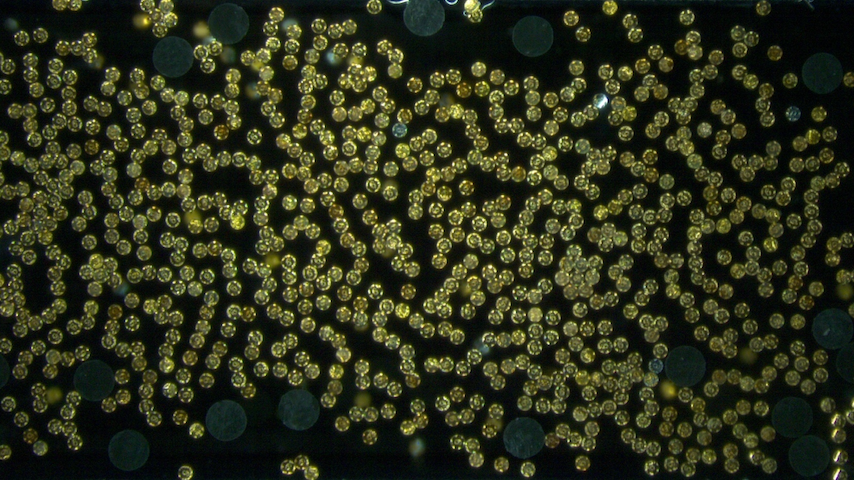
Fluid-generated torque generated by microrobot swarms can move passive objects in surprising ways—without the need for physical contact.
Scientists across the globe see great potential in microrobotic systems, or groups of minuscule robots that can interact with the environment, to support biomedical applications, precision manufacturing, microscale assembly, or other scenarios where traditional robotics are too large to get the job done. There’s only one issue: how to successfully control those systems they are designing for the work.
“When you are working with microrobots, one is not enough. You need many working together. But the challenge, when you have that many at such a small scale, is you don’t always have actuators or sensors on them to control movement—and computation is limited,” said Gaurav Gardi, a post-doctoral researcher in the Physical Intelligence department at the Max Planck Institute for Intelligent Systems (MPI-IS).
Now, researchers from the MPI-IS, in collaboration with the University of Michigan and Cornell University, have discovered a new way to move microrobotic assemblies without the need for programming or remote control. Instead, they are relying on the controllable fluid flows provided by the tiny machines’ own innate physics.
“The paradigm of self-organization is a very old one. It’s almost a century old,” Gardi said. “And we saw that the local forces exerted by the components of this system are kind of the key to that self-organization.”
Discover the Benefits of ASME Membership
Originally, Gardi and his colleagues started to work with this particular microrobotic system, made up of disc-shaped microrobots that are each approximately 300 micrometers in diameter, to observe and understand the different interactions that might occur when an external magnetic field was applied.
“We started with a thought: ‘What happens if we can tune the attraction or repulsion of these discs in real-time, while they are in operation? What happens if you have something with the microrobots that is not magnetic and just passive cargo, how would they behave?’” he said. “As we tried different parameters, we started to see all kinds of emergent behaviors.”
As the experiments began, the researchers noticed that as each disc rotated, that motion spurred the collective to rotate. The system, as a whole, moved the “fluid flow around in a circular way,” exerting fluidic torque on surrounding objects, moving them without physical contact, Gardi said.
“This system has very rich dynamics,” he continued. “And we soon saw that a lot of different behaviors can emerge depending on the kind of external magnetic actuation you apply to it—many of them counterintuitive—and that was very exciting because we are not programming the system that way. Those behaviors are strictly coming out because of the system’s physics.”
In fact, as the researchers started to experiment, they observed different behaviors in the bots when they changed the number and spinning rate of the microrobots. They found they could use the microrobots to rotate a small gear as well as carry and move objects much larger and heavier than the microrobots themselves—all through coordinated fluid flows. They even observed a crawling behavior, where the microrobots moved over a ring, resembling “ants crawling on something,” when the team reduced how quickly the discs spun.
“[The crawling] was very counterintuitive,” he said. “But we saw so many different behaviors emerge. You change something little and see something very different happen in the system. It’s very exciting because, by studying the physics, we can see these new, previously unseen behaviors that could be used in different applications in the future.”
As for next steps, the research team is looking to apply machine learning methods like reinforcement learning to help them understand all the potential interactions that might happen in these assemblies—as well as what signals they need to give in order to achieve certain tasks. But, in the meantime, Gardi hopes that other engineers will think beyond traditional control systems in robotics as they look to design microrobotic systems.
“Roboticists tend to think they need certain types of actuators and sensors to control each and every robot in an assembly precisely—and that will let us know how the group will behave,” he said. “But this is limiting at smaller scales. We need to understand the physics so instead of fighting against these fluid torques, and trying to precisely control every robot, we can instead embrace the idea of controlling the interactions. We are likely to get much more dynamic and versatile behavior than what we could get trying to program fixed types of behaviors.”
Kayt Sukel is a technology writer and author in Kansas City.
“When you are working with microrobots, one is not enough. You need many working together. But the challenge, when you have that many at such a small scale, is you don’t always have actuators or sensors on them to control movement—and computation is limited,” said Gaurav Gardi, a post-doctoral researcher in the Physical Intelligence department at the Max Planck Institute for Intelligent Systems (MPI-IS).
Now, researchers from the MPI-IS, in collaboration with the University of Michigan and Cornell University, have discovered a new way to move microrobotic assemblies without the need for programming or remote control. Instead, they are relying on the controllable fluid flows provided by the tiny machines’ own innate physics.
“The paradigm of self-organization is a very old one. It’s almost a century old,” Gardi said. “And we saw that the local forces exerted by the components of this system are kind of the key to that self-organization.”
Discover the Benefits of ASME Membership
Originally, Gardi and his colleagues started to work with this particular microrobotic system, made up of disc-shaped microrobots that are each approximately 300 micrometers in diameter, to observe and understand the different interactions that might occur when an external magnetic field was applied.
“We started with a thought: ‘What happens if we can tune the attraction or repulsion of these discs in real-time, while they are in operation? What happens if you have something with the microrobots that is not magnetic and just passive cargo, how would they behave?’” he said. “As we tried different parameters, we started to see all kinds of emergent behaviors.”
As the experiments began, the researchers noticed that as each disc rotated, that motion spurred the collective to rotate. The system, as a whole, moved the “fluid flow around in a circular way,” exerting fluidic torque on surrounding objects, moving them without physical contact, Gardi said.
“This system has very rich dynamics,” he continued. “And we soon saw that a lot of different behaviors can emerge depending on the kind of external magnetic actuation you apply to it—many of them counterintuitive—and that was very exciting because we are not programming the system that way. Those behaviors are strictly coming out because of the system’s physics.”
In fact, as the researchers started to experiment, they observed different behaviors in the bots when they changed the number and spinning rate of the microrobots. They found they could use the microrobots to rotate a small gear as well as carry and move objects much larger and heavier than the microrobots themselves—all through coordinated fluid flows. They even observed a crawling behavior, where the microrobots moved over a ring, resembling “ants crawling on something,” when the team reduced how quickly the discs spun.
“[The crawling] was very counterintuitive,” he said. “But we saw so many different behaviors emerge. You change something little and see something very different happen in the system. It’s very exciting because, by studying the physics, we can see these new, previously unseen behaviors that could be used in different applications in the future.”
As for next steps, the research team is looking to apply machine learning methods like reinforcement learning to help them understand all the potential interactions that might happen in these assemblies—as well as what signals they need to give in order to achieve certain tasks. But, in the meantime, Gardi hopes that other engineers will think beyond traditional control systems in robotics as they look to design microrobotic systems.
“Roboticists tend to think they need certain types of actuators and sensors to control each and every robot in an assembly precisely—and that will let us know how the group will behave,” he said. “But this is limiting at smaller scales. We need to understand the physics so instead of fighting against these fluid torques, and trying to precisely control every robot, we can instead embrace the idea of controlling the interactions. We are likely to get much more dynamic and versatile behavior than what we could get trying to program fixed types of behaviors.”
Kayt Sukel is a technology writer and author in Kansas City.


The use of robotics in industrial settings continues to accelerate at a rapid pace. Explore this collection to learn more about automation, cobots, AI-enabled robots, customized robots, and drones.